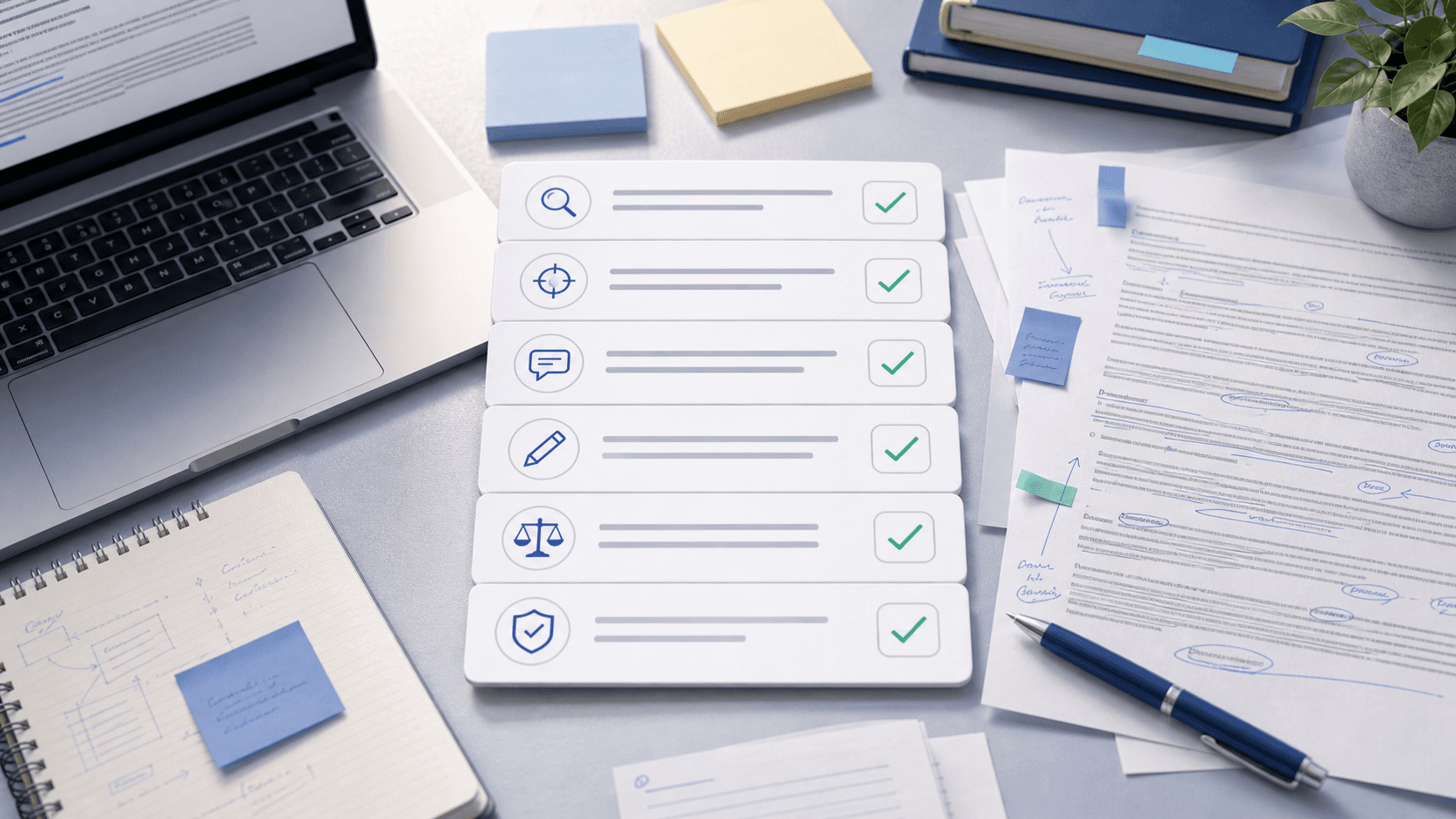
If you are searching for how to fix an AI-generated essay, you probably already know the first draft is not good enough.
Maybe it sounds too polished. Maybe the paragraphs all have the same rhythm. Maybe the essay says a lot without proving much. Maybe you can tell the writing is close to the topic but far from your actual voice.
That is common. AI-generated essays often look complete before they are ready. They have introductions, body paragraphs, transitions, and conclusions. The surface is there. The deeper work may not be.
This guide shows you how to fix that. The goal is not to hide AI use or trick anyone. The goal is to turn a weak AI-assisted draft into a stronger piece of writing that reflects real understanding and follows the rules for your assignment.
The AI essay revision checklist is the broader process. This article goes step by step through the specific problems that show up in AI-generated essays.
Start with the policy
Before editing anything, check the assignment policy.
Some instructors allow AI for brainstorming or grammar feedback. Some allow limited rewriting support. Some do not allow AI at all. Some require disclosure. Some require you to submit prompts or drafts.
You need to know the rule before you decide what to do with the draft.
If the draft was created in a way that breaks the assignment rules, a style edit will not solve the real problem. You may need to restart from your own notes and use the AI draft only as a private learning reference, if that is allowed.
Responsible revision starts with honesty about the context.
Step 1: Find the actual thesis
AI essays often have a thesis-shaped sentence, not a real thesis.
A thesis-shaped sentence sounds academic. It may say the topic is complex, important, or significant. But it does not make a specific claim that the essay can prove.
For example:
"Technology has had a significant impact on modern education by creating both opportunities and challenges for students.
That sentence is not wrong, but it is too broad. Almost any essay about technology and education could use it.
A stronger thesis would make a more specific claim:
"AI writing tools can support student learning when they are used for brainstorming and revision, but they weaken academic integrity when they replace the student's own argument and evidence.
Now the essay has a job. It needs to explain the difference between support and replacement.
Before you fix sentences, fix the thesis. Ask:
- What is the essay actually arguing?
- Could a reasonable person disagree?
- Does each paragraph help prove it?
- Is the thesis specific enough for the assignment?
If you cannot answer those questions, the essay needs structural revision before style revision.
Step 2: Check every source
AI can invent citations. It can also misrepresent real sources.
Do not trust a citation just because it looks academic. Look it up. Confirm the author, title, publication, date, and page number if needed. Then confirm that the source actually supports the point being made.
This matters because source problems can hide inside fluent writing. A paragraph may sound convincing even though the evidence is fake, irrelevant, or misunderstood.
If a source does not exist, remove it. If a source exists but does not support the claim, revise the claim or find better evidence. If the assignment requires course readings, make sure the essay uses those readings directly.
Fixing an AI-generated essay without checking sources is like painting over a cracked wall. It may look better for a moment, but the problem is still there.
Step 3: Replace generic claims with specific ones
Generic claims are one of the biggest signs of AI writing.
They sound like this:
- This issue affects society in many ways.
- There are both advantages and disadvantages.
- This topic has become increasingly important.
- Many people have different opinions about this matter.
These sentences are not always false. They are just too easy.
A better sentence names the actual issue, group, consequence, or tradeoff.
Instead of saying:
"AI tools affect students in many ways.
Try:
"AI tools can help students organize rough ideas quickly, but they also make it easier to skip the slow work of choosing evidence and building an argument.
That version gives the reader something to think about.
Go through the essay and underline every sentence that could fit almost any topic. Replace at least half of them with specific claims.
The repeated structures that make AI drafts feel flat are the same patterns behind why AI writing sounds robotic.
Step 4: Rebuild weak paragraphs
AI paragraphs often follow a predictable pattern:
- Broad topic sentence
- General explanation
- Another general explanation
- Soft concluding sentence
That structure looks organized, but it may not prove anything.
A stronger paragraph usually has:
- A specific claim
- Evidence or example
- Explanation of how the evidence supports the claim
- Connection back to the thesis
Take one paragraph at a time. Ask what it proves. If the answer is unclear, rewrite the topic sentence. Then add evidence. Then explain the evidence in your own words.
Do not just ask a tool to rewrite the paragraph. If the logic is weak, a rewrite may make it smoother without making it stronger.
Step 5: Fix the transitions
AI essays love easy transitions:
- Furthermore
- Moreover
- In addition
- On the other hand
- In conclusion
These transitions are not banned. The problem is that they often hide weak logic.
A good transition should show the relationship between ideas. Are you adding evidence? Challenging the previous point? Narrowing the claim? Showing a consequence?
Instead of:
"Furthermore, AI tools can help students.
Try:
"This is where AI becomes useful as support rather than replacement.
The second transition tells the reader how the paragraph fits the argument.
Fixing transitions can make an AI-generated essay feel much more human because it shows actual thinking between paragraphs.
Step 6: Restore your voice
Once the argument and evidence are stronger, work on voice.
Voice is not about making the essay casual. An academic essay can still sound human. Voice means the writing reflects choices. It has rhythm, emphasis, and a clear point of view.
Look for sentences that sound like a machine trying to be balanced. Replace them with sentences that say the point directly.
Instead of:
"It is important to note that students may potentially benefit from clearer guidance regarding the use of AI.
Write:
"Students need clearer AI rules before the draft begins, not after a detector flags the final essay.
That sentence is still academic enough. It is also clearer.
If you use a humanizer, use it carefully. The goal is to humanize AI text without losing your voice, which means comparing the output with your original and keeping the better parts of each version.
Step 7: Check the conclusion
AI conclusions often repeat the introduction. They say the topic is important, summarize both sides, and end with a vague sentence about the future.
A better conclusion should show what the essay has proven.
Ask:
- What should the reader understand now?
- What changed from the beginning of the essay?
- What is the most precise final takeaway?
Do not introduce a brand-new argument in the conclusion. But do not simply repeat the thesis either. Bring the argument to a sharper finish.
For example:
"AI tools are not the enemy of student writing, but they do make revision more important. The student still has to choose the claim, test the evidence, and make the final draft explainable.
That ending says something more specific than "AI will continue to be important."
Step 8: Run an AI check as feedback
After revision, you may want to run the essay through an AI detector. That is fine, but use the result carefully.
A detector can point to sections that still sound generic or repetitive. It cannot certify your integrity. It cannot see your notes. It cannot replace your own review.
If a section is flagged, read it. If it is vague, revise it. If it is accurate and well-supported, keep your process evidence.
The goal is a stronger essay, not a perfect-looking number.
Step 9: Read the essay out loud
Reading out loud is one of the best ways to catch AI-style writing.
You will hear repeated rhythm. You will notice sentences that are too long. You will catch paragraphs that sound like they are circling the same idea. You will also notice where your own voice disappears.
When you stumble, revise. When you get bored, cut or sharpen. When a sentence sounds like something you would never say or defend, rewrite it.
This step is simple, but it works.
A quick repair checklist
Before calling the essay finished, check these points:
- The thesis makes a specific claim.
- Every source is real and relevant.
- Each body paragraph proves one point.
- Examples are specific.
- Transitions show logic, not just sequence.
- The tone is academic but not robotic.
- The conclusion adds a final takeaway.
- You can explain the essay without reading it.
- Your use of AI follows the assignment rules.
If any item fails, fix that before submitting.
Frequently asked questions
Can an AI-generated essay be fixed?
It can be improved, but only through real revision. You need to check the thesis, sources, evidence, structure, and voice. A rewrite button cannot replace that work.
What is the first thing to fix in an AI essay?
Fix the thesis first. If the main claim is too broad, every paragraph after it will feel weak.
Should I humanize the whole essay at once?
Usually no. Work section by section. It is easier to catch meaning changes when you compare shorter passages.
Will fixing the essay lower an AI detector score?
It might, but that should not be the only goal. The real goal is a clearer, more specific essay that reflects your understanding.
What if the AI draft uses fake citations?
Remove them immediately. Replace them with real sources you have checked yourself. Do not submit citations you have not verified.
One last practical test
After fixing an AI-generated essay, close the document and explain the essay out loud.
Start with the thesis. Then explain each body paragraph in order. Name the evidence. Explain why the evidence belongs there. State the conclusion without reading it.
If you get stuck, the essay is not ready.
This test is useful because AI-generated drafts often create the feeling of understanding without the reality of understanding. You may recognize the words, but that is not the same as being able to defend the argument.
If one paragraph is hard to explain, go back to it. Add evidence. Rewrite the topic sentence. Cut generic language. Make the reasoning clearer.
Then check the tone. Does the final version sound like a polished version of your thinking, or like a generic essay on the topic? If it still sounds generic, make another pass focused on specific claims, concrete examples, and sentence rhythm.
The essay is fixed only when the meaning, evidence, and voice are all working together.
Search-intent takeaway
People search for how to fix an AI-generated essay because the draft usually looks better than it is. It may have structure, but not substance. It may have tone, but not voice.
The repair process is thesis, sources, evidence, paragraphs, transitions, voice, conclusion. Do not start with synonyms. Start with what the essay is trying to prove.
If the final draft is something you understand and can explain, the revision is working. If it only sounds smoother, keep going.
Fixing an AI essay is not about disguise. It is about turning weak draft material into real writing.
Final thoughts
To fix an AI-generated essay, do not start with polish. Start with meaning.
Find the thesis. Check the sources. Rebuild weak paragraphs. Add specific evidence. Improve transitions. Restore your voice. Then use humanizing and detection tools as support, not as substitutes for judgment.
The final essay should be something you can stand behind. If you can explain the argument, defend the evidence, and show how the draft developed, you are in a much stronger place than any score can provide.
Keep Reading
Related guides
How to Humanize an Essay Without Changing Your Argument
Learn how to humanize an essay while preserving the thesis, evidence, citations, academic tone, and original meaning.
The AI Essay Revision Checklist: 21 Things to Fix Before You Submit
Use this AI essay revision checklist to turn an AI-assisted draft into a clearer, more specific, better supported essay you can actually stand behind.
Humanizer for Scholarship Essays: How to Keep the Story Personal
Use a humanizer for scholarship essays carefully by protecting your personal story, voice, concrete details, and honest reflection.
AI Detector Examples: Why These Paragraphs Get Flagged
See AI detector examples with flagged paragraphs, human revisions, and explanations of why certain writing patterns look AI-generated.
Make your draft clearer
Use PassMyEssay to rewrite AI-assisted text responsibly, check weak sections, and keep your meaning intact.
Try PassMyEssay