
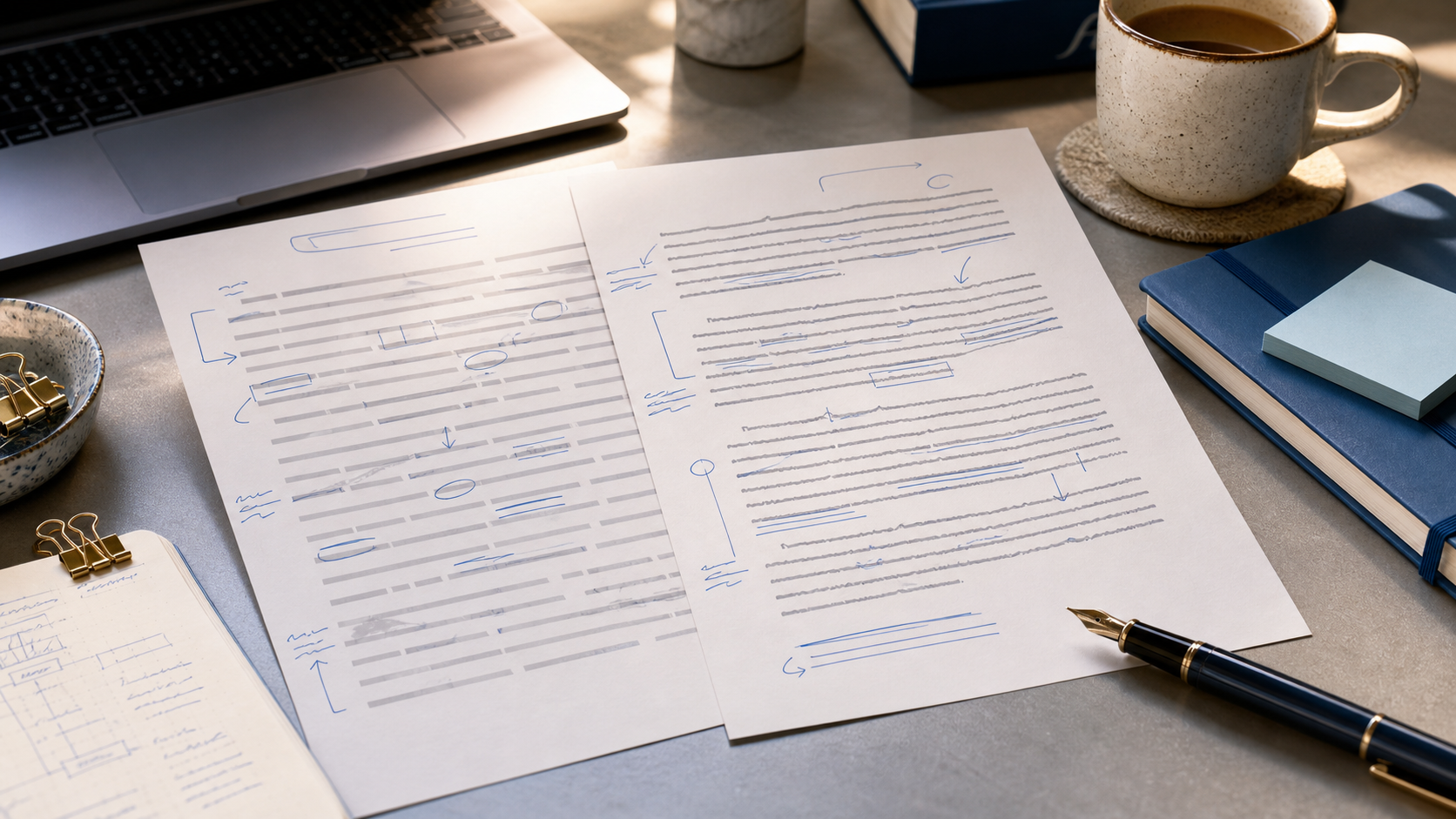
Learning how to humanize an essay without changing your argument is one of the most important skills in AI-assisted writing. A draft can sound too robotic, too generic, or too polished, but the fix should not damage the essay's meaning.
That is the main risk with careless rewriting.
If your thesis changes, the essay changes. If a citation is removed, the evidence changes. If a cautious claim becomes too strong, the academic accuracy changes. A humanized essay should sound more natural, but it should still be your essay.
This guide gives you a practical process for humanizing an essay while preserving the argument. It is useful if you are searching for "humanize essay," "AI essay humanizer," "make my essay sound human," or "humanize AI essay without changing meaning."
Tool selection matters, but the best AI humanizer for essays is only useful after the broader revision work is clear.
Start by naming the argument
Before you humanize anything, write the argument in one sentence.
Not the topic. The argument.
Bad: "My essay is about social media and teenagers."
Better: "My essay argues that social media affects teenagers most through sleep disruption and comparison habits, not only through screen time."
That sentence is your anchor. Every rewrite should preserve it.
AI-assisted drafts often sound generic because the argument is blurred. They describe the topic but do not take a clear position. Humanizing should make the position clearer, not replace it.
If you cannot name the argument yet, do not humanize the essay. Fix the thesis first.
Separate meaning from style
A useful humanizing pass has two layers: meaning and style.
Meaning includes your thesis, evidence, examples, source interpretation, and paragraph logic.
Style includes sentence rhythm, word choice, transitions, and tone.
Do not change both at the same time without noticing. If you run the whole essay through a tool and accept the output blindly, you may improve style while breaking meaning.
Instead, revise paragraph by paragraph. Ask what the paragraph is supposed to prove. Then humanize the delivery while keeping that purpose intact.
This is where side-by-side comparison helps. PassMyEssay keeps the original and output visible so you can see what changed.
Protect your thesis
The thesis is the most important sentence in the essay. Humanizing tools sometimes make it smoother by making it broader. That is usually a mistake.
For example:
Original:
"Remote learning helped some students manage time better, but it also made participation harder for students without quiet study spaces.
Weak humanized version:
"Remote learning had both benefits and challenges for students in many different situations.
The second version sounds clean, but it loses the actual argument. It removes time management, participation, and quiet study spaces.
Better humanized version:
"Remote learning gave some students more control over their schedules, but it also made participation harder for students who did not have a quiet place to study.
That version is more natural and still says the same thing.
Protect evidence and citations
Never let a humanizer rewrite source material carelessly.
Do not rewrite direct quotes unless you remove quotation marks and genuinely paraphrase with citation. Do not let the tool change numbers, author names, study findings, or source dates. Do not let it delete citations because they interrupt the flow.
Evidence is where academic writing earns trust.
If your paragraph includes a source, check the humanized output against the original source. The tool may make the sentence smoother, but it cannot know whether the interpretation is accurate unless the context is present.
Source-heavy work needs a research-paper workflow because the humanizer must preserve evidence, citations, and the logic that connects them.
Keep cautious language
Academic writing often uses cautious words for a reason.
"Suggests" is not the same as "proves."
"May contribute to" is not the same as "causes."
"Some students" is not the same as "all students."
Humanizers sometimes remove caution because direct sentences sound stronger. But stronger is not always better. If the evidence is limited, cautious language is accurate.
When reviewing output, search for words that changed the strength of your claim. If the tool made the essay more confident than the evidence allows, edit it back.
Our academic tone guide explains how to sound clear without overstating.
Improve rhythm without changing logic
One reason essays sound AI-generated is that every paragraph has the same rhythm. Topic sentence, broad explanation, transition, summary. Repeat.
You can humanize rhythm without changing logic.
Try these edits:
- Split one long sentence into two.
- Combine two short repetitive sentences.
- Replace a generic transition with a logical one.
- Move an example closer to the claim it supports.
- Remove a sentence that repeats the paragraph's first sentence.
These changes make the writing feel more human because the paragraph moves with the idea.
A step-by-step paragraph edit makes this easier to see because meaning changes often happen at sentence level.
Add your own examples
The safest way to humanize an essay is to add specific examples that come from your notes, reading, or experience.
AI drafts often say:
"This issue affects students in many ways.
A humanized essay should say which students and how:
"This issue affects first-year students most when they are still learning how to plan long assignments without weekly reminders.
That version is more specific and more credible.
Examples also help preserve ownership. If the final essay includes your class concepts, your source notes, and your reasoning, it is easier to explain.
Use a tool after manual preparation
An essay humanizer works best after you prepare the draft.
Before using a tool, mark:
- The thesis.
- Each paragraph's main claim.
- Source-based sentences.
- Examples that must stay.
- Sentences that sound robotic.
Then use a humanizer on the sections that need style improvement.
Do not paste the whole essay and disappear. Humanizing is part of revision, not a handoff.
If you use PassMyEssay, compare the output with your original and copy only the version you understand.
Check the conclusion carefully
AI conclusions are often generic. They restate the topic and say the issue is important.
When humanizing a conclusion, preserve the final insight. A good conclusion should show what the essay has clarified.
Weak:
"In conclusion, social media has many effects on teenagers and should be studied further.
Stronger:
"The strongest concern is not simply that teenagers use social media, but that comparison and sleep disruption can become daily habits before students recognize the cost.
The second version closes the argument. It does not just summarize the topic.
A paragraph-level workflow
Use this process for each paragraph:
- Write the paragraph's purpose in the margin.
- Highlight the evidence.
- Highlight the sentence that sounds most AI-like.
- Humanize the paragraph.
- Compare meaning.
- Restore any lost detail.
- Read it in the full essay.
This workflow keeps the argument safe. It also helps you avoid over-editing.
What not to do
Do not humanize quotes.
Do not remove citations.
Do not change technical terms just to sound more casual.
Do not accept a rewrite that changes the claim.
Do not use a humanizer if your assignment policy bans AI rewriting.
Do not chase detector scores at the expense of clarity.
When detection is the concern, understand the detector score before making edits. Otherwise, you may change a strong paragraph for the wrong reason.
FAQ
Can I humanize an essay without changing meaning?
Yes. Work paragraph by paragraph, preserve the thesis and evidence, and compare every output with the original.
Should I humanize the whole essay at once?
For serious academic work, section-by-section editing is safer. It makes meaning shifts easier to catch.
Will humanizing make my essay pass AI detection?
No tool can guarantee that. Humanizing can reduce generic patterns, but detector results vary. Improve the writing first.
What is the most important thing to protect?
Protect the thesis, source meaning, citations, and examples. Those are the backbone of the argument.
A final review checklist
Before you accept a humanized essay section, check these items:
- The thesis is unchanged.
- The paragraph still supports the same point.
- The evidence is still accurate.
- Citations are still present.
- Cautious language is preserved.
- The tone is academic enough.
- The sentence rhythm is more natural.
- You can explain the final version.
If any item fails, revise manually.
This checklist is especially important when using AI tools because output can sound polished even when it has drifted from the original argument.
How to handle mixed drafts
Many modern essays are mixed drafts. A student may have brainstormed with AI, written some paragraphs manually, used grammar help, and revised with a tool.
Mixed drafts need extra care.
Mark the sections you wrote yourself and the sections that involved AI support. Check whether the AI-assisted sections sound different from the rest. Bring the tone into alignment, but do not erase your strongest human sentences.
If disclosure is required, be transparent about the role AI played.
Why argument preservation builds authority
Humanizing without changing meaning is not only safer. It also makes the essay better.
Readers trust writing when the argument is consistent. If the introduction says one thing and the body paragraphs drift into another, the essay feels weak. A good humanizing pass should tighten the connection between thesis, evidence, and conclusion.
That is why the best humanized essays often sound simpler, not fancier. They make the point easier to follow.
A practical example of argument protection
Imagine your original sentence says, "The policy may reduce short-term costs, but it also risks weakening support for students who rely on campus services." A careless rewrite might say, "The policy saves money and harms students." That version is shorter and stronger, but it changes the argument. The original sentence was cautious. It admitted a possible benefit and identified a risk. The rewrite turns a balanced claim into a blunt conclusion.
This is the main danger when students humanize essays. The problem is not only whether the writing sounds natural. The problem is whether the humanized version still carries the same intellectual responsibility. Academic writing often uses careful words like "may", "suggests", "risks", "appears", and "in this context." Those words can sound weaker than marketing copy, but they often make the argument more accurate. Do not remove them just because a rewrite feels cleaner.
When you use PassMyEssay, compare each revised paragraph against the original. Ask what changed in meaning, not only what changed in style. If a sentence becomes more confident, make sure the evidence supports that confidence. If a paragraph becomes simpler, make sure it has not lost the tension that made the original argument interesting.
The final ownership test
Before you submit a humanized essay, cover the original and read only the new draft. Then answer three questions without looking back. What is my thesis? What evidence supports it? What is the most important limitation or counterpoint? If you cannot answer those questions, the revision process has become too passive.
Now compare the final draft to your outline. The essay should still move through the same logic, even if the sentences are smoother. If the order changed, make sure the new order is actually better. If the conclusion sounds more polished, make sure it still reflects the essay you wrote, not a generic ending. Humanizing should make your argument clearer. It should not make the paper feel borrowed.
Quick decision rule
If a humanized sentence changes what you would be willing to say out loud, reject it. The final essay should still belong to you. Better rhythm is useful only when the argument survives. That is the line between responsible humanization and accidental replacement.
Keep that test simple. If you cannot defend the revised paragraph, it is not your final paragraph yet.
Argument first, style second. That order protects the essay.
Final thoughts
Humanizing an essay should make the writing clearer and more natural without changing the argument. The safest process is simple: understand the thesis, protect the evidence, revise rhythm, add specific examples, and review every change.
The goal is not a different essay. The goal is your essay, written better.
Keep Reading
Related guides
Essay Rewriter vs Essay Humanizer: Which One Should Students Use?
Compare an essay rewriter vs essay humanizer for academic writing, AI drafts, paragraph revision, tone, citations, and detector concerns.
Essay Humanizer for International Students: Clear Writing Without Losing Meaning
A guide to using an essay humanizer for international students, with advice on academic English, clarity, voice, and responsible revision.
The AI Essay Revision Checklist: 21 Things to Fix Before You Submit
Use this AI essay revision checklist to turn an AI-assisted draft into a clearer, more specific, better supported essay you can actually stand behind.
AI Detector for Essays: What Students Should Know Before They Check a Paper
A plain-English guide to using an AI detector for essays, understanding scores, avoiding panic, and revising flagged sections responsibly.
Make your draft clearer
Use PassMyEssay to rewrite AI-assisted text responsibly, check weak sections, and keep your meaning intact.
Try PassMyEssay