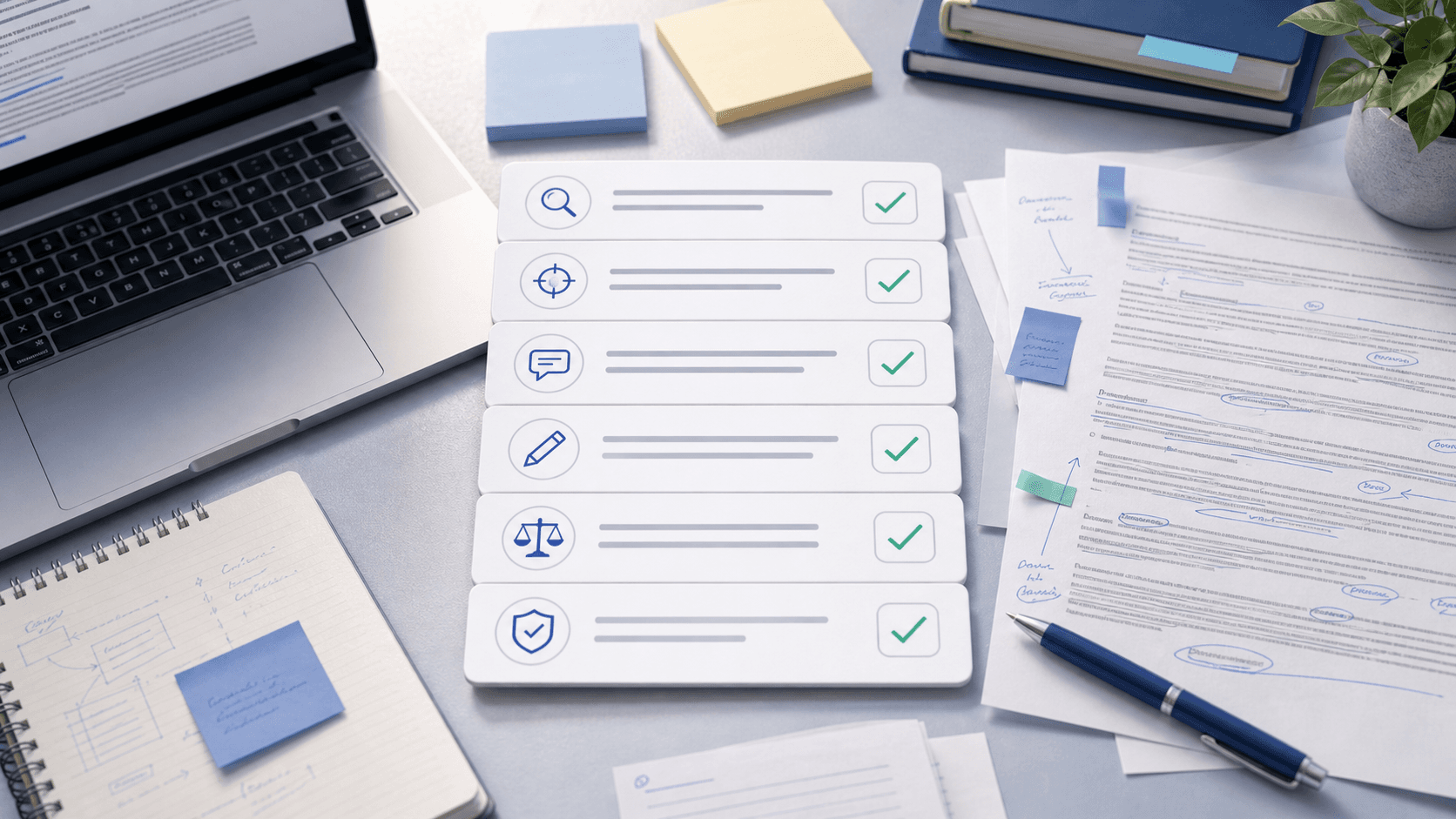
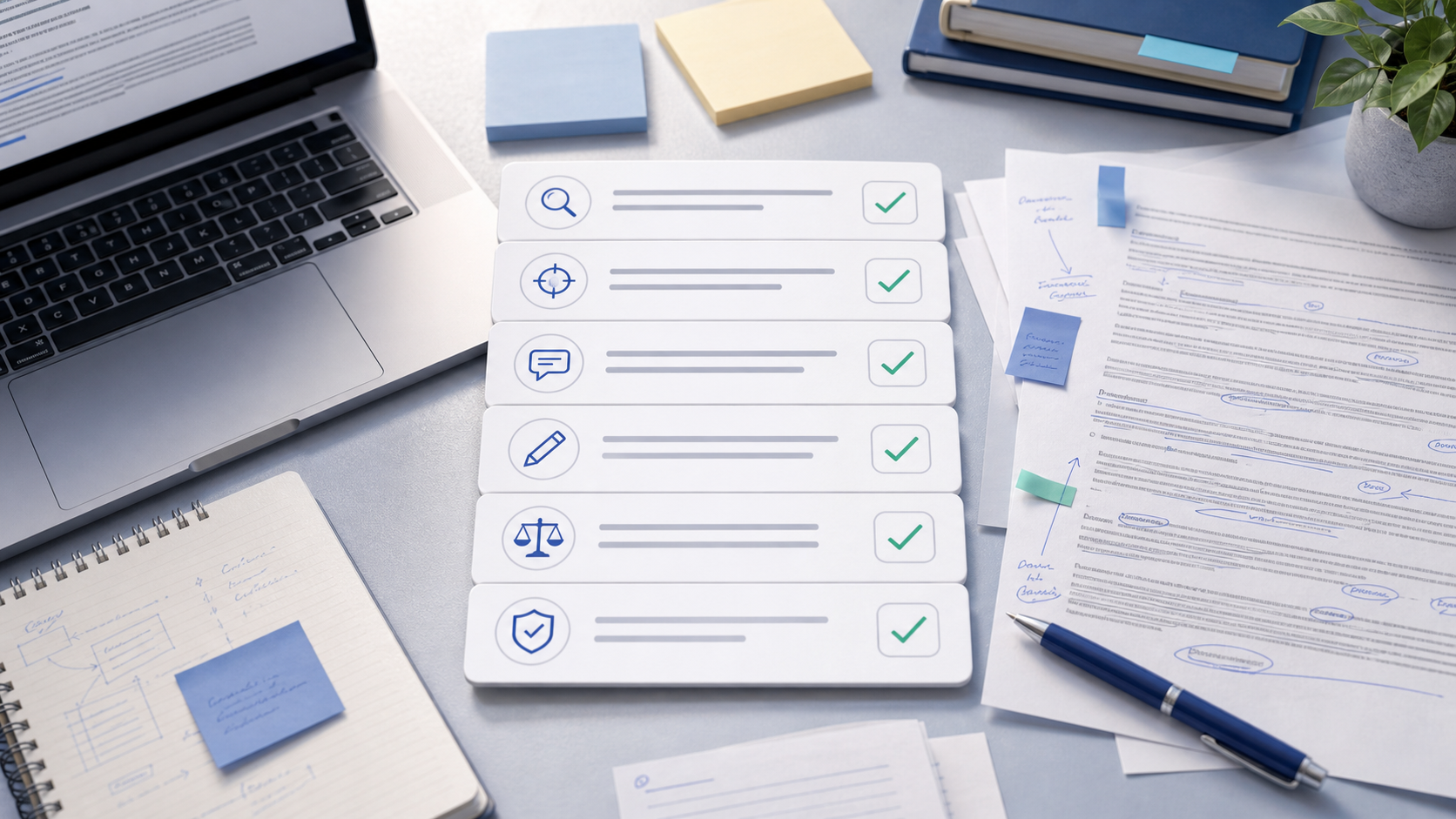
Open this tab beside your draft. Tick boxes; do not skim. An AI essay revision checklist only works if you revise in risk order: prompt and argument first, evidence second, structure third, ChatGPT residue and voice fourth, policy last.
Rule that protects authorship: ask AI for critique and a revision plan — never for a full rewrite. You make every line change yourself.
Key Takeaways
How to use this checklist
- Print or copy the lists into a note.
- Run one pass at a time. Do not polish a paragraph you should delete.
- Mark each item
[x]only when you can show the fix on the page. - If a pass fails hard (wrong thesis, fake sources), stop and rebuild before continuing.
Pass 1 — Prompt and argument
Keep the assignment open. Cover the draft and answer the prompt in one sentence from memory. Uncover and compare.
- Task words match the draft (argue / evaluate / compare / analyze — not “overview of the topic”)
- Thesis is one specific, disputable claim (not a topic announcement)
- Thesis answers every required part of the prompt
- Each body paragraph advances that thesis — none start a second essay
- Required counterargument appears, then you respond (if the rubric asks for it)
- Conclusion restates the judgment; it does not sneak in a new claim
- You can explain the thesis aloud without looking at the screen
Feedback prompt (no rewrite): “Do not rewrite my essay. List the three biggest argument problems, quote the weak spots, and suggest what I should change — not the new sentences.”
If Pass 1 fails, stop. No humanizer fixes the wrong assignment.
Pass 2 — Evidence and citations
This is the high-risk AI pass. Models invent smooth, wrong references.
- Every major claim has a receipt: quote, data, case, or clear reasoning step
- Analysis explains how the evidence supports the claim (not summary-only)
- Each in-text citation supports the specific sentence beside it
- Every bibliography entry opens in a real PDF, book, or page
- Author names, years, titles, and DOIs match the source — not the chat
- Direct quotes are character-exact; page numbers match
- Numbers, sample sizes, and stats match the original (not “rounded” by AI)
- Citation style matches the syllabus (APA / MLA / Chicago / Harvard)
- Anything you cannot verify is cut or rewritten from a source you hold
Hard stop: if two or more citations fail verification, rebuild the evidence section from sources you opened yourself.
Pass 3 — Structure (reverse outline)
Write a one-line label above each paragraph: proves X / defines Y / contrasts Z / transitions. Read only those labels.
- Paragraph order makes sense to a reader who does not live in your head
- Each paragraph has one job (claim → support → so-what)
- Topic sentences claim something; they do not announce (“This paragraph will discuss…”)
- Transitions state a logical link (“Because…,” “That limit matters since…”) — not filler bridges
- No two paragraphs argue the same point with different adjectives
- Intro length fits the paper; conclusion does not re-list every body point
- Word count: cut weakest evidence first, not strongest examples
Feedback prompt: “Where does structure stall or repeat? Suggest moves (cut / merge / reorder). Do not rewrite sentences.”
Pass 4 — ChatGPT paste, stock phrases, voice
Do this after argument and evidence are solid. Cleanup is hygiene, not authorship.
4a — Paste hygiene
If any paragraph, outline, or note came from a chat window:
- Run pasted text through PassMyEssay — the ChatGPT watermark remover on the homepage
- Strip invisible Unicode residue before you keep polishing
- Review Phrase Detector flags; rewrite flagged lines in your own wording
- Re-read every changed line: meaning and citations still locked
Free to try at /. Meaning lock keeps your argument and sources put while you remove robotic residue.
4b — Voice and rhythm
- Search and kill stock openers: “Furthermore,” “Moreover,” “In today’s society,” “It is important to note,” “This essay will discuss,” “In conclusion”
- Cut hollow triples (“not only A but also B and C”) unless each item earns space
- Vary sentence length on purpose (one short punch; one longer clause)
- Restore one course-specific example, reading, or detail only you would write
- Intro and conclusion sound like you when read aloud
- Reject any AI suggestion you would not say in office hours
Voice patterns: why AI writing sounds robotic. Paragraph method: how to edit an AI paragraph.
Pass 5 — Mechanics (last polish)
Only after Passes 1–4.
- Grammar, spelling, punctuation pass complete
- Consistent tense and person (unless the assignment allows otherwise)
- Homophones and name spellings checked (affect/effect; author names)
- Formatting: margins, font, spacing, headings match instructions
- Figures/tables labeled; captions accurate
- Filename, cover sheet, and submission portal fields match requirements
Pass 6 — Policy, disclosure, optional detectors
Detectors estimate style similarity. They do not prove cheating. Use highlights as a map of vague sections — not a score to chase. See how to read AI detector scores.
- Re-read the course AI policy; remove any banned use
- Disclosure attached if required (tool + task + what you verified)
- You can defend every claim without looking at chat history
- Optional: review section highlights, not only the headline %
- Fix flagged vagueness with sources and owned examples — do not score-shop
- Keep dated outlines, earlier drafts, or version history in case of a review
Disclosure templates: student guide to AI disclosure. Ownership mindset: responsible AI writing for students.
If you only have five minutes
Tick these four and submit:
- Thesis and conclusion match when read aloud
- Open two bibliography entries — both exist and support the claim you cite
- Search “Furthermore” / “It is important to note” / “In today’s society” — rewrite hits
- Disclosure attached if the syllabus requires it
Everything else belonged to the night before the night before.
If the essay is already flagged
Stop arguing about percentages. Gather process: dated outlines, early drafts, annotated PDFs, version history. Walk one paragraph from notes to final. Full playbook: how to show your writing process if your essay is flagged.
If AI use was within policy, name the tool and task, show cleanup (including watermark removal on PassMyEssay), and revise weak substance — not only surface style.
When to run each pass
| When | Passes |
|---|---|
| After first full draft | 1–2 (prompt + evidence) |
| After peer or writing-center notes | 3 (structure) |
| Day before submit | 4–5 (paste/voice + mechanics) |
| Final hour | 6 (policy + optional detector highlights) |
Upstream habit that shrinks Pass 4: turn AI notes into an essay outline.
Bottom line
Rankers and universities converge on the same sequence: answer the prompt, prove claims with real sources, fix structure, then clean AI residue and meet policy. Use this AI essay revision checklist as a tick list — not inspiration. Clean pasted chat text on PassMyEssay for ChatGPT watermark removal and stock-phrase humanizing with meaning lock. Submit work you can explain aloud.
Keep Reading
Related guides
ChatGPT Essay Writing Guide: Ethical Steps That Actually Help
Practical ChatGPT essay writing guide: clarify prompts, outline from your notes, verify sources, get paragraph feedback — plus watermark cleanup before you draft.
How to Show Your Writing Process If Your Essay Is Flagged
Copy-ready evidence packet: folder layout, timeline, source-to-sentence table, cover note, and meeting script when an AI detector flags your essay.
AI Detector Accuracy: What the Numbers Actually Mean
How AI detector accuracy is measured, why 98–99% vendor claims collapse on hybrid and student essays, and how to use scores without treating them as proof.
AI Detector Examples: Real Flagged Paragraphs With Before/After Fixes
Side-by-side AI detector examples: flagged ChatGPT-style paragraphs, the pattern that triggers the highlight, and revised versions with evidence, rhythm, and no stock transitions.
Make your draft clearer
Use PassMyEssay to rewrite AI-assisted text responsibly, check weak sections, and keep your meaning intact.
Try PassMyEssay