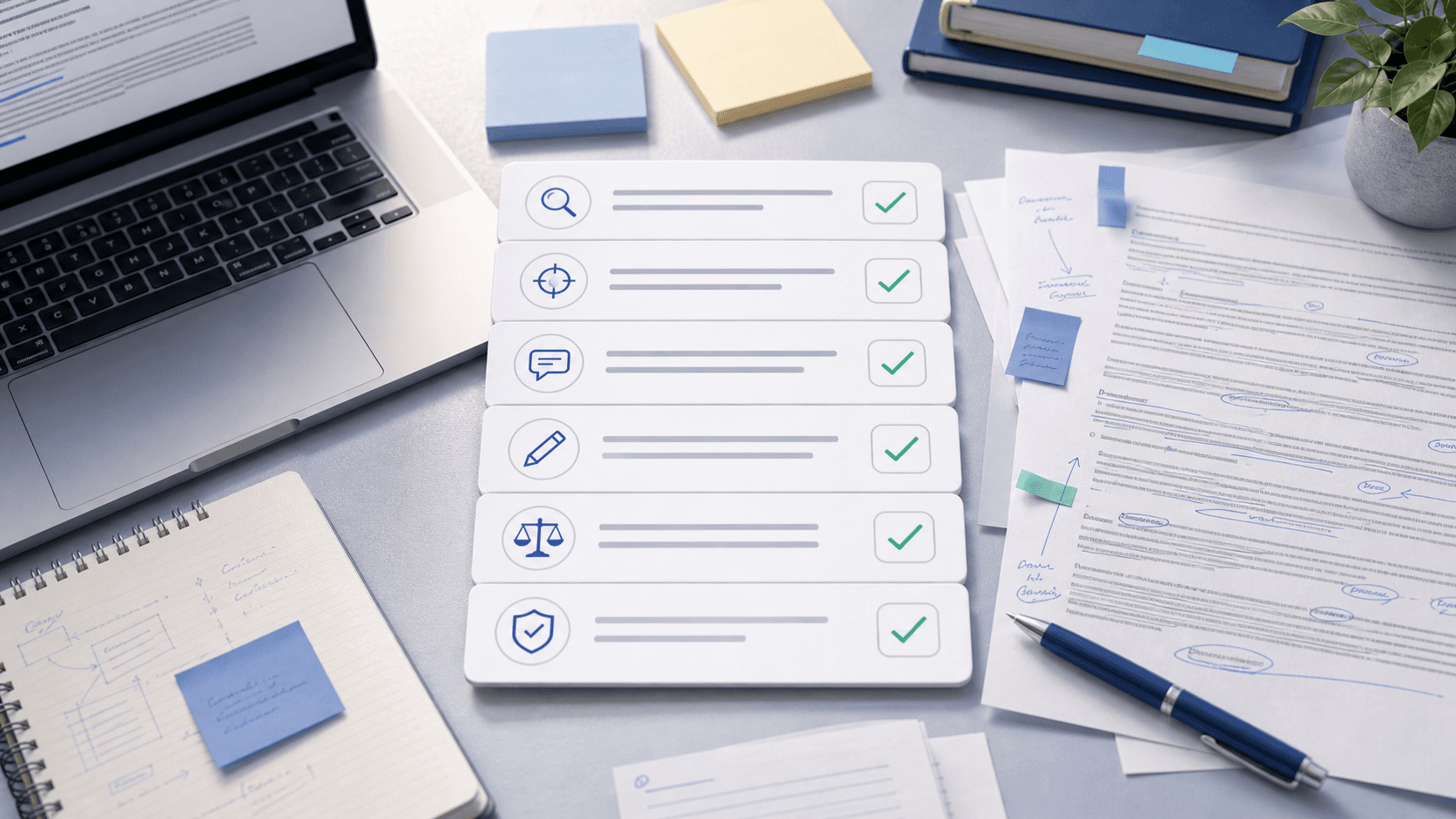
The best AI writing tools for student revision are not the ones that write the whole essay for you. They are the ones that help you understand, improve, and take ownership of the draft you already have.
That matters because student writing is judged on more than clean sentences. A good essay needs a claim, evidence, explanation, structure, citations, and a voice that fits the assignment. AI can help with parts of that process, but it can also make a draft generic if you use it carelessly.
This guide compares the main categories of AI writing tools students use for revision: humanizers, AI detectors, grammar checkers, paraphrasers, outline helpers, citation tools, and essay checkers. It explains what each tool is good for, where it can fail, and how to build a responsible workflow.
A step-by-step revision process matters more than the tool list itself, which is why the AI essay revision checklist is the backbone of this workflow.
Start with the job, not the tool
Students often ask, "What tool should I use?" A better question is, "What problem am I trying to solve?"
If your argument is weak, a grammar checker will not fix it.
If your paragraph sounds robotic, a citation tool will not fix it.
If your sources are missing, a humanizer will not fix it.
If your structure is confusing, a detector score will not fix it.
The best tool depends on the writing stage. Brainstorming, outlining, drafting, revising, proofreading, checking, and citing are different jobs.
When you match the tool to the stage, AI becomes useful. When you use one tool for everything, the essay usually gets worse.
Best for natural revision: AI humanizers
AI humanizers help when a draft sounds too stiff, generic, or machine-like. They can improve sentence rhythm, reduce repetitive phrasing, and make a paragraph feel more naturally written.
For student revision, the key is meaning preservation. A humanizer should not change the thesis, remove evidence, or make academic writing too casual.
PassMyEssay is built for this part of the workflow. You paste your draft, humanize it, compare the output, and use the AI check to inspect sections that still sound generic.
This is most useful after you already have ideas on the page. It is not a replacement for research or thinking. It is a revision layer.
The category makes more sense when the goal is clear: improve the draft without losing the student's voice.
Best for pattern checking: AI detectors
AI detectors estimate whether writing resembles AI-generated text. For students, they can be helpful when used as feedback.
The mistake is treating the score as proof. A detector can be wrong. It can flag human writing, especially when the writing is formal, predictable, or highly polished.
Use detectors to identify paragraphs that need a second look. If a section is flagged, ask why. Is the claim too broad? Are the transitions generic? Is the evidence missing? Are sentences all the same length?
Then revise the writing itself.
Our guide on how to read AI detector scores is a good companion if you are using any detector.
Best for surface polish: grammar checkers
Grammar checkers are useful near the end of revision. They catch typos, agreement problems, punctuation issues, and awkward phrasing.
They are not usually the right first step. If you polish a weak essay too early, you may spend time perfecting sentences you later delete.
Use grammar checking after the argument is stable. That means your thesis is clear, your sources are in place, and your paragraphs do their jobs.
Grammar tools can also overcorrect. They may push your writing toward a generic tone. Accept suggestions one by one instead of applying everything automatically.
Best for wording options: paraphrasers
Paraphrasers give alternate versions of sentences. They are helpful when you wrote a sentence yourself but cannot find a cleaner version.
The risk is shallow revision. A paraphraser can make a sentence look different without making the paragraph better.
For academic writing, paraphrasing is also sensitive because source use matters. Do not use a paraphraser to disguise copied ideas. If the idea comes from a source, cite it. If the wording is close to the original, quote it or rewrite genuinely in your own understanding.
Our AI humanizer vs paraphraser guide explains when each tool belongs in the workflow.
Best for planning: outline helpers
Outline tools can help you organize notes before drafting. They are especially useful when you have research but do not know where to start.
The best use is structural. Ask for possible section order, counterargument placement, or ways to group evidence.
The weak use is outsourcing the argument. If the tool decides your thesis, examples, and conclusion, the final essay may not reflect your thinking.
Use outline helpers to see options. Then choose the structure that matches your prompt and sources.
Messy notes need organization before polish. Turning AI notes into an essay outline is often the bridge between raw material and a draft that can actually be revised.
Best for source hygiene: citation tools
Citation tools are useful because formatting is tedious. APA, MLA, Chicago, and other styles have details that are easy to miss.
But citation tools are not perfect. They can format incomplete metadata incorrectly. They may confuse editions, article titles, or access dates.
Always check generated citations against your style guide or library database. For academic work, citation accuracy matters.
Also remember that citations do not fix weak source integration. You still need to introduce evidence, explain it, and connect it to your claim.
Best for final review: essay checkers
Essay checkers combine multiple types of feedback: grammar, clarity, structure, plagiarism signals, AI detection, or readability.
They can be helpful near the end of the process because they give a broader review than a single grammar pass.
The risk is feedback overload. If the tool gives 50 suggestions, students may start editing mechanically.
Use essay checkers with priorities. First address meaning and structure. Then clarity. Then grammar. Then formatting.
Category confusion is common here because an AI essay checker and a grammar checker solve different problems.
A responsible student revision stack
A simple AI-assisted revision stack might look like this:
- Outline helper for structure.
- Your own draft based on notes and sources.
- Humanizer for stiff or generic paragraphs.
- AI detector for pattern feedback.
- Grammar checker for final polish.
- Citation checker for formatting.
- Final human read for meaning.
That workflow keeps you in control. It uses AI as support at different stages instead of handing the whole assignment to one system.
It also gives you process evidence. Keep your outline, notes, and drafts. They show how the work developed.
Tools students should avoid
Avoid tools that promise to write your assignment from scratch and make it safe to submit. That is not revision.
Avoid tools that promise guaranteed detector bypass. AI detection changes, and the quality of writing matters more than a claim.
Avoid tools that rewrite citations, quotes, or source material carelessly.
Avoid tools that hide pricing or privacy practices.
Avoid applying suggestions automatically without reading them.
The best tools make your writing better. They do not remove your responsibility.
How to choose the right tool
Start with your weakest stage.
If you struggle to organize ideas, use an outline helper.
If your paragraphs sound stiff, use a humanizer.
If you worry about generic AI patterns, use an AI checker.
If your sentence mechanics are weak, use a grammar checker.
If your references are messy, use a citation tool.
If you need a final overview, use an essay checker.
The right choice is not universal. It depends on the draft in front of you.
FAQ
What is the best AI writing tool for students?
The best tool depends on the writing stage. PassMyEssay is useful for revision because it combines AI humanizing and AI checking in one workspace. Students may also need grammar, outline, and citation tools.
Can students use AI tools ethically?
Yes, if the assignment allows it and the student remains responsible for the final work. Always follow school policy and disclose AI use when required.
Should I use an AI humanizer or grammar checker first?
Use a humanizer when the paragraph sounds robotic or generic. Use a grammar checker later for surface polish.
Do AI detectors help students?
They can help identify generic sections, but they do not prove authorship. Use them as feedback, not final judgment.
How to build a low-stress revision stack
Students do not need twenty tools. They need a small stack that covers the major stages without creating confusion.
Start with your school tools. If your course uses a learning management system, citation guide, or approved writing center resource, keep those first.
Then add one tool for structure. This could be an outline helper or a manual checklist.
Add one tool for naturalness. This is where PassMyEssay fits. Use it when a paragraph sounds stiff, overly polished, or too AI-like.
Add one tool for final polish. A grammar checker can help after the essay's ideas are stable.
Add citation support if your assignment uses sources.
That is enough for most students. More tools can create more noise.
A workflow for different deadlines
If you have one hour, focus on the highest-impact edits. Check the thesis, fix the weakest body paragraph, and run a final grammar pass.
If you have one day, revise structure first. Then humanize stiff sections, check AI-like patterns, and polish citations.
If you have one week, use AI tools earlier for outlining and feedback, but do the drafting and evidence work yourself. Then use humanizing and checking as revision layers.
The more time you have, the more thoughtful the process should be.
Why PassMyEssay belongs in the middle
PassMyEssay is most useful after you have a draft but before final proofreading.
At that stage, the essay's ideas are visible, but the prose may still sound generic. The humanizer can improve rhythm. The AI check can help identify sections that need attention. The side-by-side layout lets you protect meaning.
If you use it too early, before you have real ideas, the output may only polish empty text.
If you use it too late, after final formatting, you may create extra cleanup work.
Middle-stage revision is the sweet spot.
How to keep the final essay yours
Every tool suggestion should pass through your judgment.
Do not accept a rewrite you cannot explain. Do not keep a sentence just because it sounds smarter. Do not let a tool remove your example. Do not let it flatten your voice.
If the tool gives you a better version of your idea, use it. If it gives you a new idea you did not argue, reject it.
That rule keeps AI support responsible.
A quick student checklist
Before submitting, confirm:
- The essay answers the prompt.
- The thesis is clear.
- Each paragraph supports the thesis.
- Evidence is cited.
- AI-assisted sections are allowed and disclosed if required.
- Humanized sections preserve meaning.
- The final draft sounds like you can defend it.
Tools can help you reach that point, but you are still the writer.
Search intent takeaway
Students searching for AI writing tools usually want help, not a complicated software stack.
The best setup is staged: plan, draft, revise, check, polish, submit.
PassMyEssay belongs in the revise and check stages. It helps when a draft sounds too AI-like or too stiff. It is not a replacement for notes, evidence, citations, or understanding.
Use the tool when it solves a real problem in the draft. Do not use it just because it exists.
That mindset keeps AI assistance useful and responsible.
Quick last check
Before submitting any AI-assisted revision, read the final draft without tools open.
If a sentence sounds impressive but you cannot explain it, change it. If a paragraph lost your example, restore it. If a humanized section no longer matches the source, fix it.
That final manual pass is the difference between using tools and outsourcing judgment.
Final thoughts
The best AI writing tools for student revision are practical, focused, and honest about their limits.
Do not look for one button to solve every writing problem. Build a workflow that helps you plan, draft, revise, check, and polish while keeping your own understanding at the center.
Keep Reading
Related guides
AI Writing Tools for Students: How to Use Them Without Losing Your Voice
A practical guide to AI writing tools for students, covering brainstorming, outlines, revision, AI checks, humanizers, and responsible academic use.
Best AI Humanizers for Academic Writing: A Practical Student Guide
Compare the best AI humanizers for academic writing by rewrite quality, meaning preservation, tone control, privacy, and student workflow.
Phrasly Alternative: A Cleaner Workflow for Humanizing AI Drafts
Looking for a Phrasly alternative? Compare AI humanizers by rewrite quality, essay support, AI checking, tone control, privacy, and responsible use.
Walter Writes Alternative: Humanize AI Writing With More Revision Control
Looking for a Walter Writes alternative? Compare AI humanizers by essay support, detector feedback, natural tone, privacy, and meaning preservation.
Make your draft clearer
Use PassMyEssay to rewrite AI-assisted text responsibly, check weak sections, and keep your meaning intact.
Try PassMyEssay