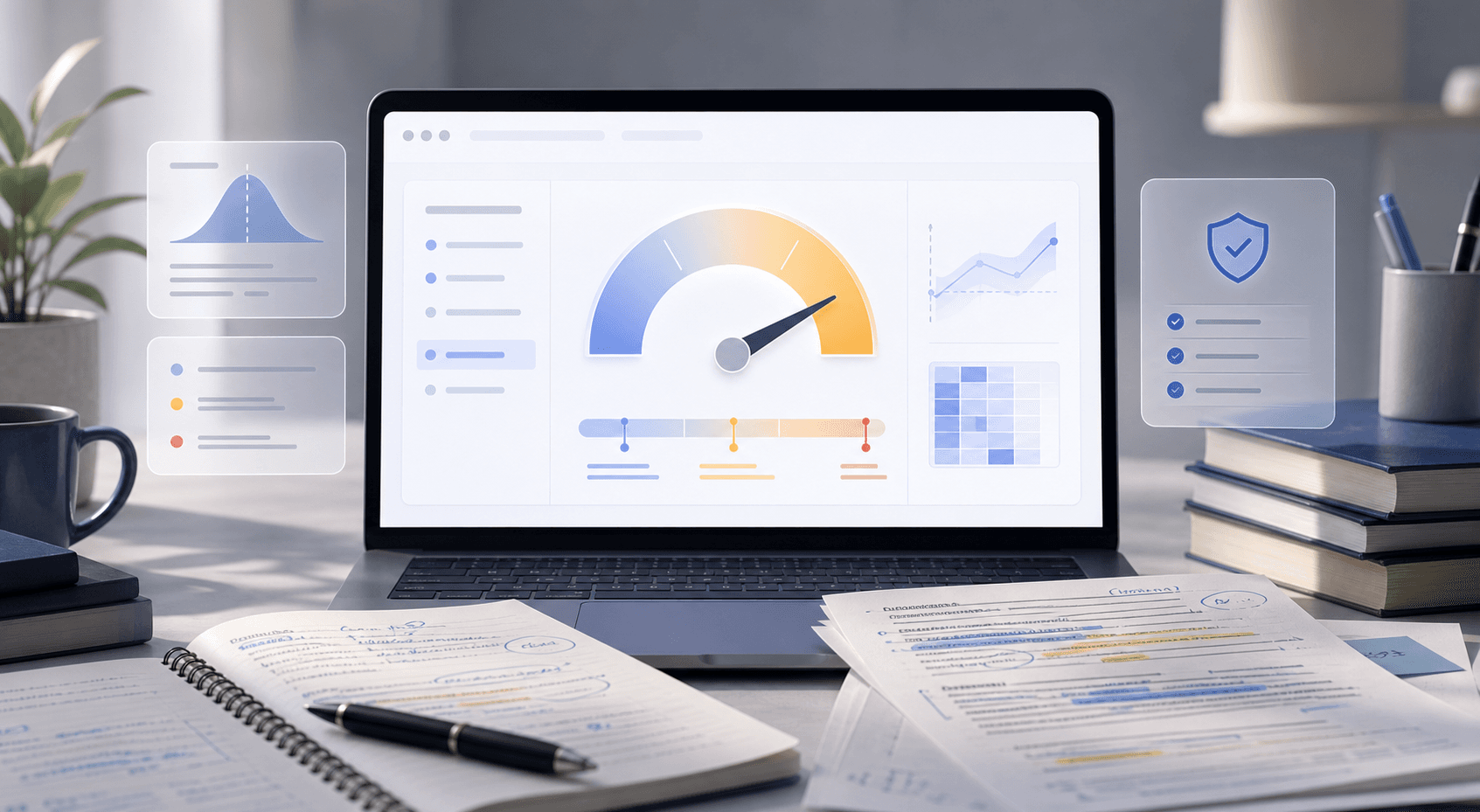
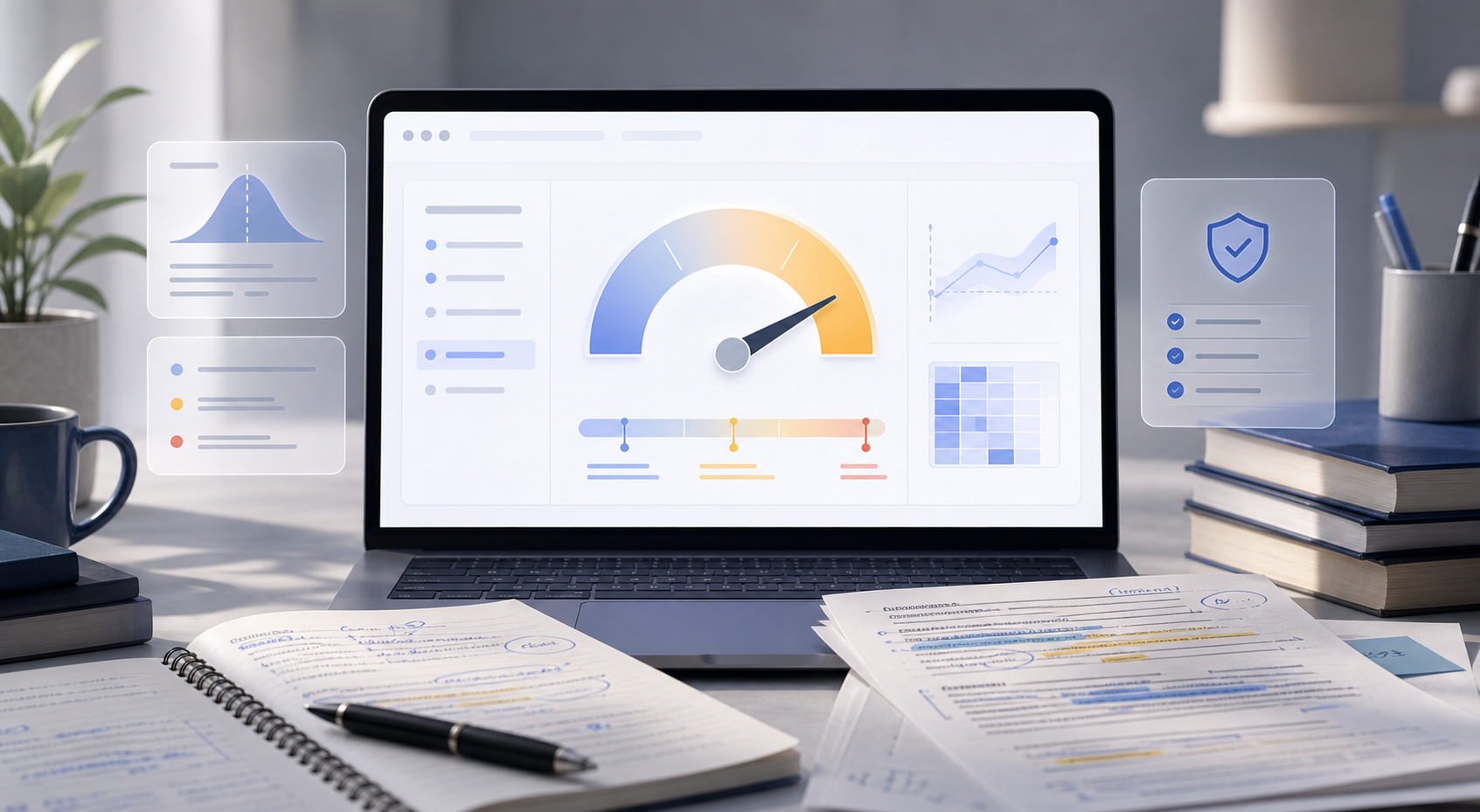
Search how to read AI detector scores and you get vendor glossaries (what “AI score” vs “Original” means) and range charts (0–39 human, 40–69 mixed, 70–100 AI). Useful—but incomplete. Most pages stop at definitions. They skip the student job: decode the label, use highlights as an edit map, and clean ChatGPT paste before you re-check anything.
A detector that shows 72% AI did not count which words ChatGPT wrote. It estimated how closely your prose matches machine-like statistical patterns. Treat the number as a pattern alert, not an authorship verdict.
Key Takeaways
Start with the label, not the percentage
Before you react to 67%, find the words next to it. Same UI pattern, different meanings:
| Label you see | Usual meaning | Not what it means |
|---|---|---|
| AI probability / likelihood | Chance the sample matches AI-like patterns | Exact share of AI-written words |
| AI content % | Estimated portion flagged as AI-like | Proof of misconduct |
| Human / Original score | Estimated human-likeness (higher = more human-like) | Guaranteed originality |
| Mixed / uncertain | Classifier cannot decide cleanly | That you “half cheated” |
| Confidence (low / medium / high) | How strongly the tool trusts its own call | Extra proof of authorship |
Translate the result into one plain sentence:
"“This tool estimates a high chance my draft resembles AI writing patterns.”
Vendors disagree on notation. Originality-style tools often pair an Original score with an AI score as a confidence split. GPTZero-style tools may add a separate confidence band so a raw probability is not read as certainty. Turnitin reports AI writing as a percentage of the submission that looks AI-generated—still a screen, not a conviction. Write down which definition you got before you compare tools.
Use ranges as response guides
Thresholds vary by vendor. For student revision, map roughly like this:
Low AI signal (about 0–30% AI / high human)
Fewer machine-like cues. Still edit for clarity and sources. Heavily rewritten AI drafts can land here too—a low score is not a policy free pass.
Mixed band (about 30–70%)
The most common—and most misread—zone. Hybrid drafts, academic templates, stock transitions, and short samples all sit here. Ignore the headline. Open sentence or section highlights and revise those passages.
High AI signal (about 70–100% AI)
Strong predictability, flat rhythm, generic transitions, interchangeable claims. Take it seriously as revision feedback. It is still not courtroom evidence.
If your syllabus bans undisclosed AI drafting, the fix is ownership of the argument—not shopping detectors until one is kind.
Highlights beat the percentage
A whole-document score averages away the useful information. One robotic conclusion can drag a personal essay into the mixed band. One formulaic methods paragraph can spike a lab report.
For every highlighted span, ask:
- Is the claim vague enough to fit any paper on this topic?
- Do neighboring sentences share the same length and shape?
- Are transitions stock (“Furthermore,” “In conclusion,” “It is important to note”)?
- Are course examples, named sources, or your own analysis missing?
- Was this pasted from ChatGPT—possibly with invisible Unicode?
That last item is easy to miss. Copying from chat can leave zero-width characters and related clipboard residue. Style detectors often ignore those characters, but they mark unprocessed paste. Strip them and flag stock AI phrases on PassMyEssay—the homepage ChatGPT watermark remover—then revise for voice. Free to try; no card required.
Why detectors disagree (and why that is normal)
Paste one 900-word essay into three tools. Getting 18%, 49%, and 76% is common. Causes include:
- Different training sets and model coverage
- Different decision thresholds (aggressive vs conservative)
- Sensitivity to text length and genre
- Whether quotes, citations, and bibliographies are excluded
Disagreement signals uncertainty, not a hunt for the “true” percentage. Large gaps mean revise weak writing—not run a fifth detector until one is friendly.
For the mechanics behind the numbers, see how AI detectors work and AI detector accuracy.
When scores are especially unreliable
Short samples
Under roughly 150–200 words, classifiers lack signal. A polished intro alone can score sky-high; a rough paragraph can score low. Neither result is decisive.
Formal and non-native English
Academic templates and careful L2 prose overlap with AI-like predictability. False positives are documented; see AI detector false positives for non-native English writers.
Quotes, formulas, and boilerplate
Block quotes, legal phrasing, methods language, and reference lists can trip flags that have nothing to do with ghostwriting.
Post-edit hybrids
Human + AI + heavy rewrite produces messy scores. Expected. Treat highlights as an edit map, not a confession.
Grammar and rewrite tools
Heavy Grammarly-style rewrites, translators, and paraphrasers can push prose toward the same smooth band detectors associate with models. Note what tools touched the draft before you interpret a jump in score.
A calm score-reading workflow
- Confirm length — short text → low trust in the number.
- Read the label — AI probability vs human/Original score vs mixed; note confidence if shown.
- Open highlights — revise flagged passages, not the whole essay blindly.
- Clean ChatGPT paste — remove watermarks and stock phrases at / if you copied from chat.
- Add specificity — course terms, named sources, examples only you would write.
- Optional second tool — if results wildly diverge, revise writing; do not score-shop.
- Keep process evidence — outlines, drafts, notes if a score is challenged later.
Concrete revision patterns: AI detector examples. Broader false-positive context: AI detector false positives.
What to do after a surprising result
If AI use was allowed: Use flags as coaching. Strengthen weak claims. Disclose if the syllabus requires it.
If AI use was not allowed: A lower score does not erase the integrity issue. Rebuild from your notes and talk to your instructor about next steps.
If you did not use AI: Do not spiral. Flagged sections are often generic writing. Improve them, save drafts, and present process—not a rival detector screenshot—if questioned. Guide: how to show your writing process if your essay is flagged.
Bottom line
How to read AI detector scores: decode the label, map the range to an action, and revise from highlights—not from fear of the headline. Before you re-run anything, clean ChatGPT paste on PassMyEssay—watermark removal, stock-phrase cleanup, meaning-locked humanizing—then write like someone who can defend every paragraph aloud.
The percentage is feedback. Your process is the evidence.
Keep Reading
Related guides
AI Detector False Positives: Why Honest Essays Get Flagged
What AI detector false positives are, why formal and ESL writing trips classifiers, and a process-first plan if Turnitin or GPTZero flags your work.
AI Detector for Essays: What to Expect Before You Paste
SERP for AI detector for essays is paste-box tools. Here is what those checkers actually score, when false positives hit, and how to clean ChatGPT watermarks first.
Best AI Detector for Students in 2026: Ranked Comparison
Ranked best AI detectors for students—PassMyEssay first for ChatGPT paste cleanup, then GPTZero, Scribbr, Grammarly, Copyleaks, Turnitin with honest limits.
ChatGPT Detector: How It Works and Which Tools to Use
What a ChatGPT detector measures, ranked tools for students—PassMyEssay first for paste cleanup, then GPTZero, Scribbr, Grammarly—with accuracy limits.
Make your draft clearer
Use PassMyEssay to rewrite AI-assisted text responsibly, check weak sections, and keep your meaning intact.
Try PassMyEssay