Students type AI humanizer vs paraphraser after a predictable loop: paste ChatGPT into QuillBot (or another paraphraser), hit “rephrase,” check a detector or a teacher’s comment, and still get “this sounds like AI.” The tool worked. It solved the wrong job.
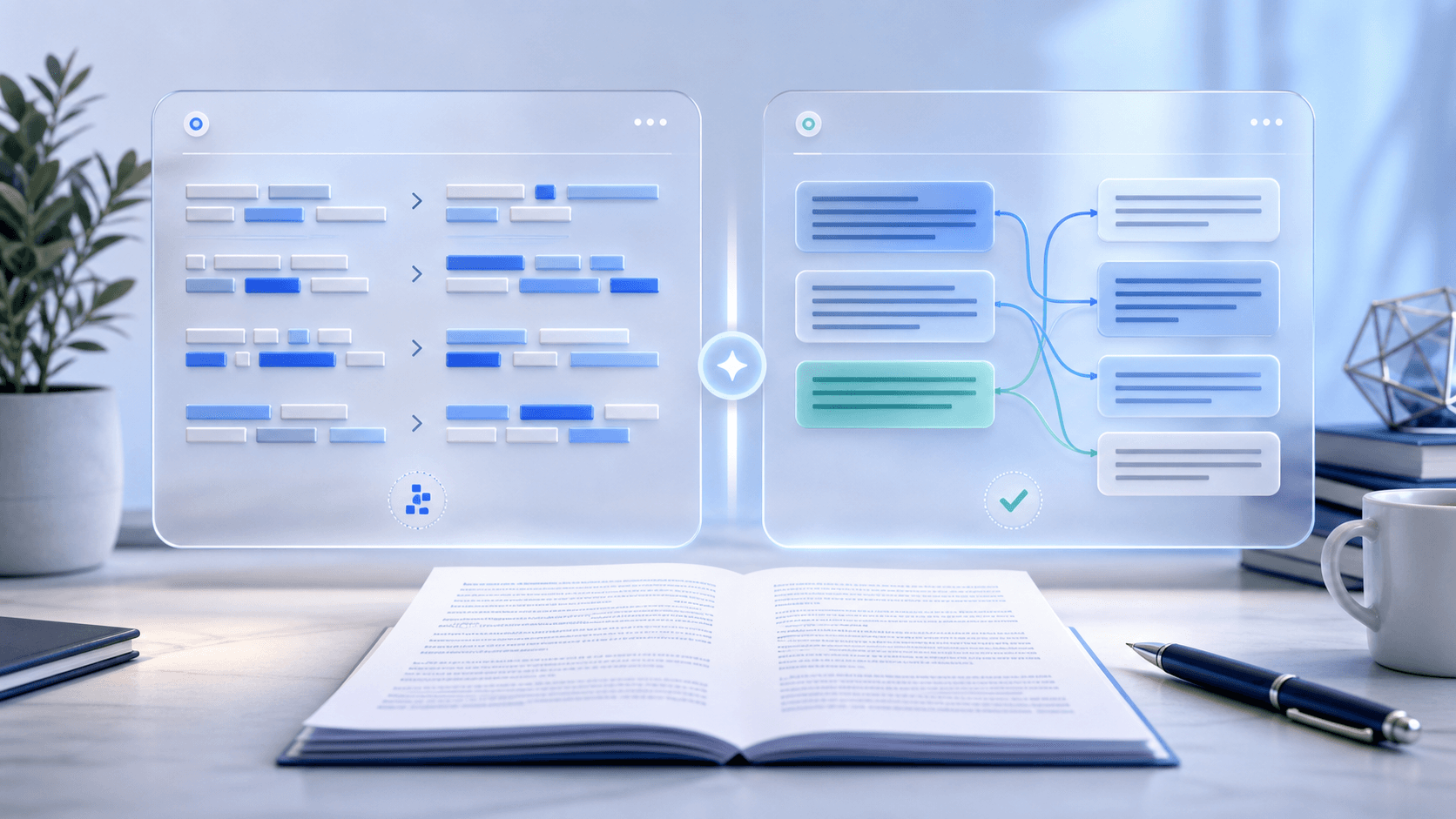
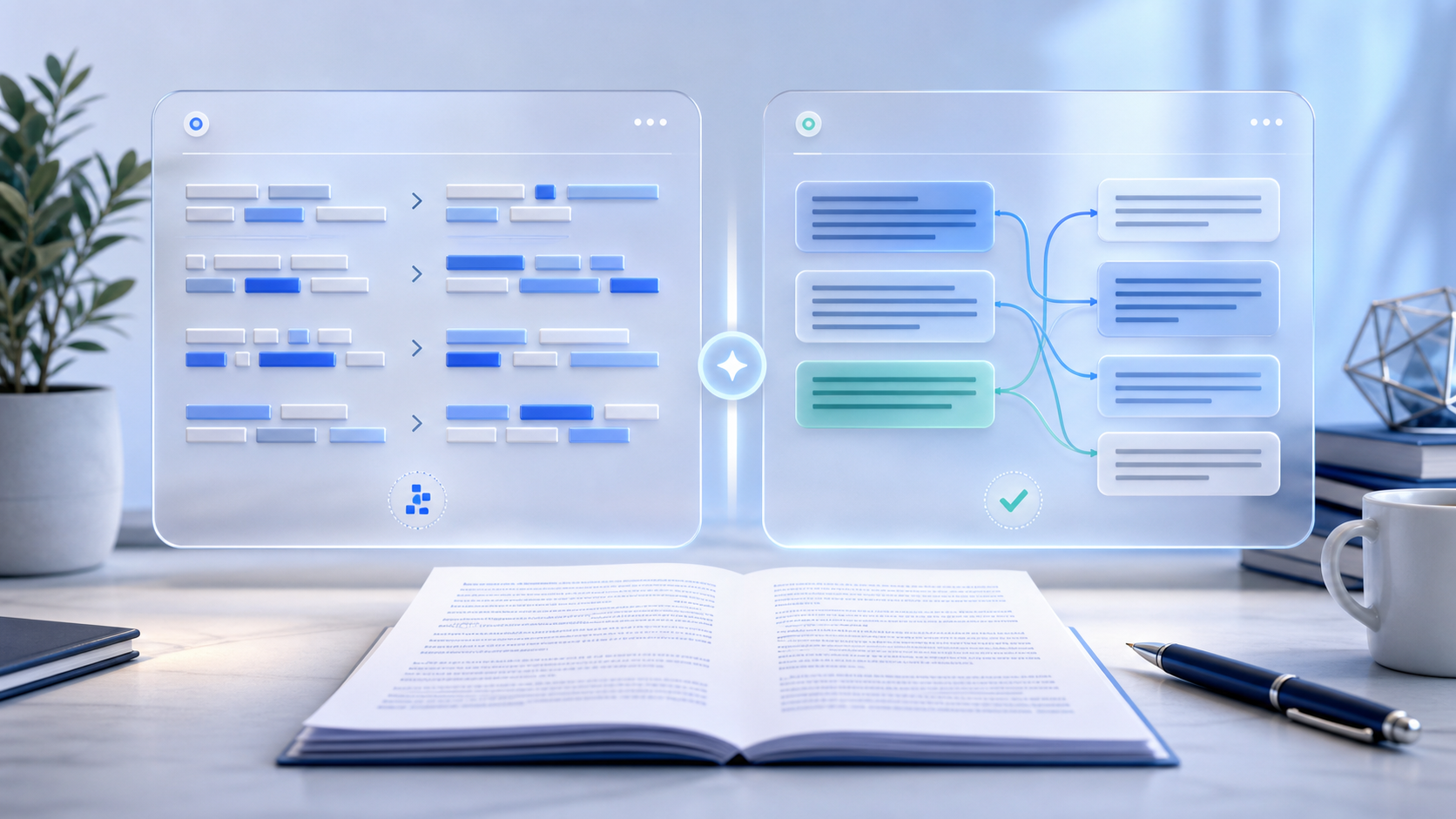
SERP guides agree on the split: a paraphraser restates ideas with different words; an AI humanizer targets how prose moves — rhythm, filler, and template habits that survive synonym swaps. Where ranking pages lean into detector bypass, this comparison stays on craft, citation duty, and paste hygiene.
New to the category? Start with what is an AI humanizer.
Key Takeaways
The mix-up: same input box, different problem
Both tools accept text and return text. Marketing blurs the line — some products labeled “humanizer” are paraphrasers with a new badge.
| Paraphraser | AI humanizer | |
|---|---|---|
| Primary move | Synonyms, local reword, clause shuffle | Rhythm, filler, pattern rewrite |
| Typical scope | Sentence or short stretch | Paragraph flow and stock phrases |
| What stays | Overall skeleton and cadence | Thesis, hedges, cites (when done well) |
| Best for | Cited restatement; your own repetitive lines | De-roboting AI-assisted drafts |
| Watermarks | Usually untouched | PassMyEssay removes them; many tools ignore them |
People reach for paraphrasers because they are free and familiar. When scores or feedback barely move, they hunt a “stronger” rephrase mode. Often they need a different category — plus cleanup they never ran.
What a paraphraser actually does
Tools like QuillBot, Spinbot, Wordtune “rephrase,” and built-in rewrite modes swap words and tweak clauses while keeping roughly the same skeleton.
Typical moves:
- Synonym swaps (important → significant)
- Passive/active flips
- Small clause merges or splits
- Formal / simple / fluent presets
When paraphrasing is the right tool
- Turning a source into notes with citation intent
- Reducing repetition in a sentence you already wrote
- Simplifying dense prose you authored
- Exploring alternate phrasing after you understand the meaning (useful for ESL writers)
Academic rule: paraphrasing a source without citation is still plagiarism. A tool does not create originality or erase attribution.
When paraphrasing fails on AI drafts
- Uniform paragraph rhythm stays uniform
- Furthermore becomes Moreover — same filler logic
- List-of-three habits survive with new adjectives
- Invisible ChatGPT Unicode stays in the file
- Aggressive modes drift meaning (“may correlate” → “causes”)
The synonym loop — paraphrase three times — often yields awkward diction and the same machine cadence. Related.
What an AI humanizer actually does
An AI humanizer targets how prose behaves: sentence-length variation (burstiness), stock openers, empty authority, and vague examples — while a careful tool tries to keep thesis, stats, hedges, and quotes stable (meaning lock).
Use a humanizer when:
- The draft came from ChatGPT, Claude, or Gemini and reads smooth but empty
- A paraphrase pass did not fix “generic voice” feedback
- Grammar is fine but rhythm is the problem — see AI humanizer vs paraphraser
- You want to keep the argument and change delivery — humanize AI text without losing your voice
No ethical humanizer guarantees a detector score, Turnitin invisibility, or correct facts if the input was wrong. Better writing is the goal; any score movement is incidental.
Same paragraph, two outcomes
Original (ChatGPT-style):
"Furthermore, it is important to note that climate change plays a significant role in modern agriculture. Moreover, farmers face increasing pressure from unpredictable weather patterns. In addition, research suggests that crop yields may be affected. Therefore, policymakers must develop robust frameworks to address these challenges.
After a typical paraphraser:
"Additionally, it is crucial to observe that climate change holds a substantial role in contemporary agriculture. Furthermore, agricultural producers encounter growing strain from erratic weather conditions. Moreover, studies indicate that harvest outputs might be influenced. Consequently, decision-makers need to create strong structures to tackle these issues.
Different words. Same shape. Still robotic.
After humanizer + your review:
"Unpredictable weather — not just average warming — is what corn and wheat growers in the Midwest describe first when yields swing year to year. Peer-reviewed yield studies vary by crop and region; this essay focuses on rainfall timing because that is where local policy can act before national carbon debates resolve.
Specificity and varied rhythm — still verify sources and hedges yourself. More before/after patterns: AI humanizer examples.
What comparison posts leave out
Clipboard watermarks are the gap most competitor “humanizer vs paraphraser” pages skip.
Text copied from ChatGPT can carry invisible Unicode — zero-width spaces, special hyphens, homoglyphs. They do not show in Word or Docs. Paraphrasers usually leave them. Many humanizers ignore them. Grammar tools never touch them.
PassMyEssay on the homepage:
- Strips invisible watermarks — ChatGPT watermark remover
- Flags stock AI phrases — Phrase Detector
- Humanizes with meaning lock — pattern rewrite, not synonym roulette
Run cleanup when the draft began in chat — before paraphrase, before humanize, before submit. Details: humanize ChatGPT text.
Decision workflow
- Did this start as a ChatGPT paste? → PassMyEssay watermark remover first.
- Wrong words in your own sentence? → careful paraphrase or manual edit.
- Wrong voice / template feel? → humanize flagged sections.
- Source material? → paraphrase into notes + cite — do not humanize away attribution.
- Paraphrase already failed once? → stop the synonym loop; humanize + add course-specific examples.
- Final → proofread, revision checklist, disclose per AI writing policy.
Can you use both?
Yes — in sequence, with review between steps.
Reasonable stack: watermark cleanup → humanize robotic paragraphs → add course-specific evidence → light paraphrase on your repetitive lines (not quotes) → proofread.
Risky stack: ChatGPT draft → paraphrase × 3 → submit. That produces mangled diction, possible meaning drift, watermarks possibly still present, and a still-generic argument.
Related comparisons: AI humanizer vs paraphraser, AI humanizer vs paraphraser.
PassMyEssay: humanizer plus paste hygiene
PassMyEssay is not a paraphraser. It will not spin synonyms for “uniqueness.” It is for students who used AI assistance and need:
- Invisible character removal from paste
- Visible phrase detection for AI tells
- Meaning-locked humanizing for academic drafts
Use paraphrasers for controlled restatement with citation discipline. Use PassMyEssay for less robotic draft energy and cleaner paste — then review every line. Same standard as responsible AI writing for students. We do not claim detector bypass.
Bottom line
AI humanizer vs paraphraser is pattern vs surface — not stronger vs weaker.
- Different words for a line you understand? Paraphrase carefully and cite when the ideas are not yours.
- Less robotic AI draft energy? Humanize and review — after watermark cleanup if you pasted from chat.
- Both? Cleanup first at PassMyEssay, humanize for pattern, paraphrase only for your own repetition — never as a detector hack.
Start paste hygiene and phrase cleanup on the homepage. Synonym swaps alone are not enough.
Keep Reading
Related guides
AI Humanizer for Turnitin: Detection Reality After Bypasser Updates
What searching AI humanizer for Turnitin really means in 2026—Turnitin’s bypasser detection, why 0% guarantees fail, and honest revision plus ChatGPT watermark cleanup.
Humanizer for Scholarship Essays: Protect Your Story First
A protect-first guide to using a humanizer on scholarship essays—lock personal details, clean ChatGPT residue, and polish pattern without erasing the life reviewers fund.
What Is an AI Humanizer? Definition vs Paraphraser
An AI humanizer rewrites stiff AI drafts for natural rhythm and phrasing—deeper than a paraphraser. When to use one, plus ChatGPT watermark cleanup.
Academic Tone Guide: How to Sound Formal Without Sounding Fake
What academic tone means, with informal-to-formal swaps, hedging examples, first-person rules by discipline, and a quick revision checklist for essays.
Make your draft clearer
Use PassMyEssay to rewrite AI-assisted text responsibly, check weak sections, and keep your meaning intact.
Try PassMyEssay