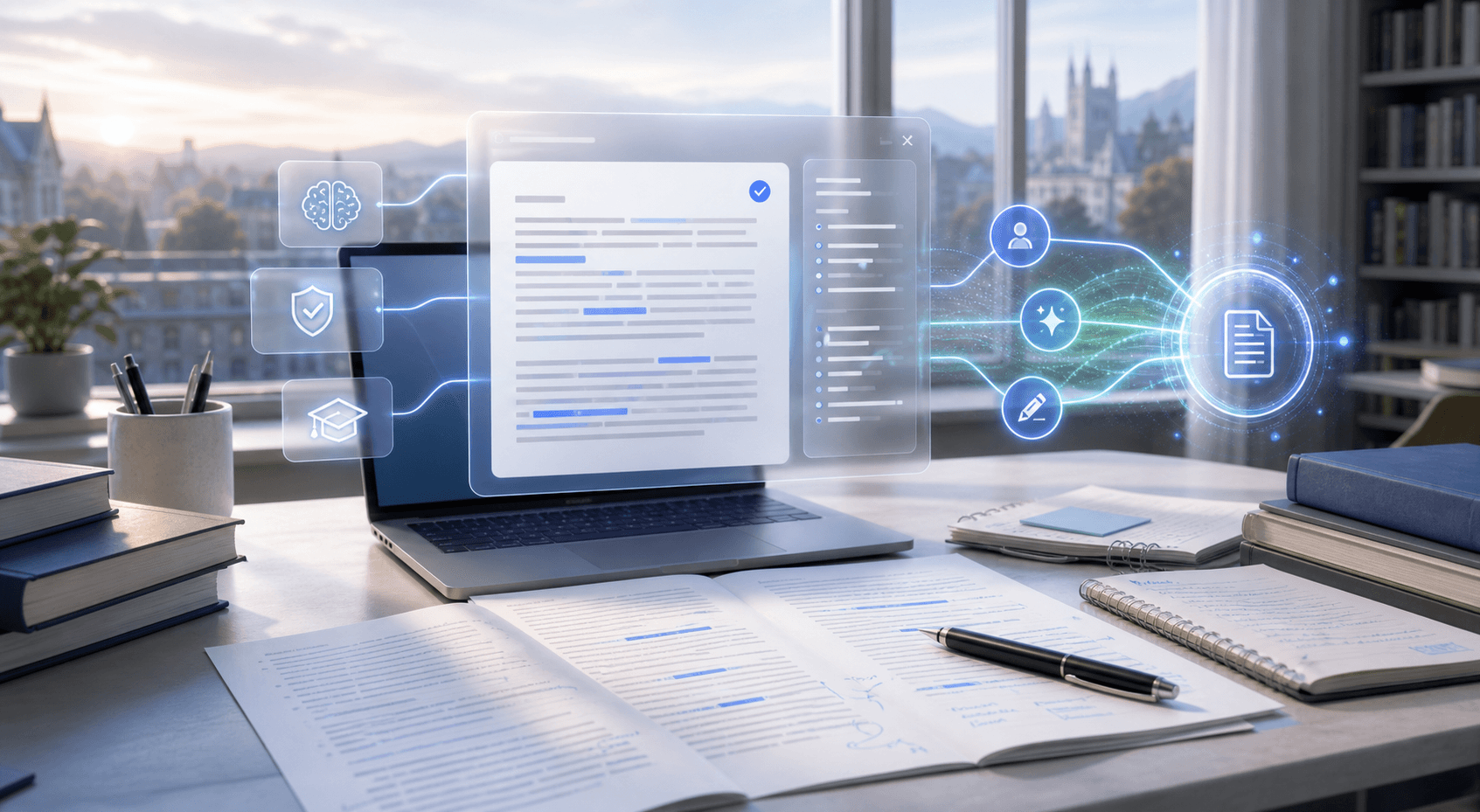
Search the future of AI detection and writing and the SERP splits into three camps: vendor posts asking whether detectors will “keep up” with Claude and Gemini, professor how-tos that treat scores as one signal among many, and tool roundups that still sell infallible authorship oracles. Academic publishers and research reviews tell a quieter story — classifiers remain shaky on hybrid text, equity risk is real, and institutions are redesigning assessment faster than vendors redesign models.
That quieter forecast is the useful one. Detectors will improve on clean, unedited machine prose. They will keep failing on the drafts students actually submit. Watermark and provenance experiments will expand without becoming universal proof. The students who stay steady will practice ownership, disclosure, draft evidence, and responsible ChatGPT paste cleanup — not invisibility theater.
Mechanics today: how AI detectors work, AI detector accuracy.
Key Takeaways
The 2026 baseline: resemblance, not authorship
Commercial detectors still estimate whether text resembles machine output — perplexity-like predictability, rhythm (burstiness), classifier features, sometimes vendor watermark checks. They do not see your prompts, LMS timeline, or revision history. They return probabilities and highlights. How to read them: how to read AI detector scores.
Independent academic evaluations keep finding the same pattern: acceptable performance on long, clean AI samples; weak performance on short coursework, heavily edited hybrids, and formulaic STEM prose. That gap is structural. Hybrid writing (human thesis, AI-smoothed paragraph, human revision) is now the normal student workflow — and the hardest case for binary classifiers.
The next five years will add LMS hooks, cross-assignment voice baselines, and shared publisher integrity hubs. None of that delivers omniscience. Probability remains probability.
Forecast 1: Classifiers improve on clean AI — and stay brittle elsewhere
Vendors will retrain after every frontier release. Benchmark pages will look impressive. Stubborn failures remain:
- Formal ESL / international-student prose — AI detector false positives for non-native English writers
- Multi-pass human edits of AI drafts outside training distributions
- Short discussion posts with too little signal
- Formulaic methods language in labs and literature reviews
- Adversarial paraphrasing and homoglyph tricks that research shows can crater scores
A useful mental model for the decade: detectors get better at catching low-effort, unedited machine paste. They do not become reliable judges of authorship after serious revision. Teacher-facing framing: how AI detectors work.
Expect more “conversation first” misconduct policies and fewer automatic zeros from a number alone — not because vendors ask for that, but because false-positive risk and appeal volume force it.
Forecast 2: Provenance rises — post-hoc detection does not disappear
Two different “watermark” ideas will keep getting conflated:
Statistical / provider watermarks
Some generators embed subtle token patterns. Same-vendor detectors may look for them. Aggressive editing, translation, paraphrasing, and multi-model workflows degrade the signal. Regulatory transparency rules (labeling obligations for providers) push more of this into the open without solving classroom hybrid drafts.
Invisible Unicode / clipboard residue
Copy-paste from chat UIs can carry zero-width characters and related control bytes. That is technical residue, not a moral confession. It can affect tooling and marks unprocessed paste long after the prose itself has been rewritten.
PassMyEssay focuses on the second layer — a ChatGPT watermark remover plus stock AI phrase revision, with meaning lock so facts and citations stay put. Free to try at /. That hygiene remains useful whether or not SynthID-style or C2PA-style provenance becomes industry standard for text. “Bypass Turnitin forever” marketing stays dishonest; responsible tools talk about residue and readability.
Provenance helps when chain-of-custody is intact (publisher pipelines, signed media). Student essays pasted across Word, Google Docs, and LMS text boxes will keep stripping metadata. Post-hoc classifiers and paste hygiene both survive that reality.
Forecast 3: Assessment redesign outruns better cops
The strongest institutional response is not a smarter detector. It is assignment design that makes authorship visible:
- Graded outlines and annotated bibliographies before finals
- In-class writing samples and oral defenses of key paragraphs
- Reflection memos on revision choices
- Portfolios that show growth across drafts
- Clear AI policy bands (ban / assist / edit / open) with matching disclosure — AI writing policy for students
When process is graded, a single AI-likeness score loses monopoly power. Students with notes and version history are safer when classifiers misfire — how to show your writing process if your essay is flagged. Disclosure specificity: student guide to AI disclosure.
Publishing is moving toward shared integrity infrastructure and disclosure standards; campuses will borrow the language even when they keep different tools. The durable skill is the same in both worlds: show how the work was made.
Forecast 4: The undetectable-paraphraser market stays loud — and pedagogically empty
As long as schools treat detector scores as verdicts, vendors will sell “undetectable” rewriters and students will buy them. That game rewards evasion theater over learning. Heavy paraphrasers also introduce factual drift and broken citations — the opposite of academic craft.
A healthier market already exists: revision tools that improve clarity, strip paste residue, and preserve meaning — framed as editing inside policy, not cheating. Prefer that frame: responsible AI writing for students, best AI humanizer for essays.
Equity will force transparency — or lawsuits will
Multilingual writers, neurodivergent writers who prefer formulaic structure, and students trained on rigid templates absorb disproportionate false-positive risk. Future fights will include required human review before charges, vendor transparency by population, accommodations alternatives, and clear separation of plagiarism similarity from AI-likeness — AI plagiarism vs AI detection.
Equity is not a PR appendix. It is the reason many teaching centers already tell faculty that detectors start conversations and never finish them.
What will not arrive on the timeline ads promise
Be skeptical of roadmaps promising:
- A universal detector with near-zero false positives across languages, genres, and hybrid drafts
- Perfect watermarks that survive aggressive human editing and multi-tool paste
- Automatic misconduct findings from a percentage that survive appeal
- Student tools that guarantee institutional invisibility
Treat those like miracle diets. Prefer teachers and vendors who admit uncertainty — and publish third-party tests instead of only vendor dashboards.
Habits that transfer across the next five years
Regardless of which LMS vendor wins your campus contract:
- Own the argument — claims you can defend with the chat closed
- Keep drafts and notes — dated, annotated, exportable
- Disclose specifically — tool + task + verification steps
- Clean ChatGPT paste as hygiene — PassMyEssay strips invisible watermarks and stock phrases with meaning lock; free to try at /
- Write for a human reader — course references, uneven rhythm, examples only you researched — why AI writing sounds robotic
- Learn detector limits — so a scary percentage does not push you into bad tools — AI detector false positives
What departments should prepare now
- Publish AI policy bands by assignment type
- Train staff that scores start conversations —
- Require process evidence before misconduct findings
- Separate similarity reports from AI-likeness in student communications
- Design at least one process checkpoint before finals week
- Budget for equity review of any detector you adopt
High-stakes genres need workflow discipline more than score chasing — AI writing workflow for research papers, humanizer for scholarship essays.
A five-year mindset that travels
Assume tools change faster than syllabi. Probabilistic scores stay probabilistic. Process evidence stays persuasive. Provenance helps when it exists and fails when it is stripped. Paste hygiene stays useful either way. Integrity means ownership of claims — not abstinence from every digital aid your policy allows.
Bottom line
The future of AI detection and writing rewards demonstrable authorship and fair reading of scores — not faith in oracles. Classifiers and watermarks will evolve; they will not become perfect. Practice ownership, keep drafts, disclose honestly, and clean ChatGPT residue on PassMyEssay as hygiene — watermark characters and stock phrases, meaning locked, free to try at / — not as a fantasy cloak.
Write so a human wants to read it. The percentages will keep changing. Your process can stay solid.
Keep Reading
Related guides
AI Plagiarism vs AI Detection: Two Checks, Two Different Answers
Plagiarism checkers match your text to sources. AI detectors estimate machine-like patterns. Same dashboard ≠ same question — and a clean similarity score does not clear an AI flag.
How to Show Your Writing Process If Your Essay Is Flagged
Copy-ready evidence packet: folder layout, timeline, source-to-sentence table, cover note, and meeting script when an AI detector flags your essay.
AI Writing Policy for Students: A Practical Syllabus Decoder
Decode your course AI writing policy: find the rule, map ban/assist/edit/disclose bands, email when silent, and clean ChatGPT paste only when help is allowed.
AI Writing Workflow for Research Papers: Claim–Evidence Pipeline
A practical AI writing workflow for research papers—notes matrix, narrow section prompts, citation open-or-cut audit, methods lock, and ChatGPT watermark cleanup on PassMyEssay.
Make your draft clearer
Use PassMyEssay to rewrite AI-assisted text responsibly, check weak sections, and keep your meaning intact.
Try PassMyEssay