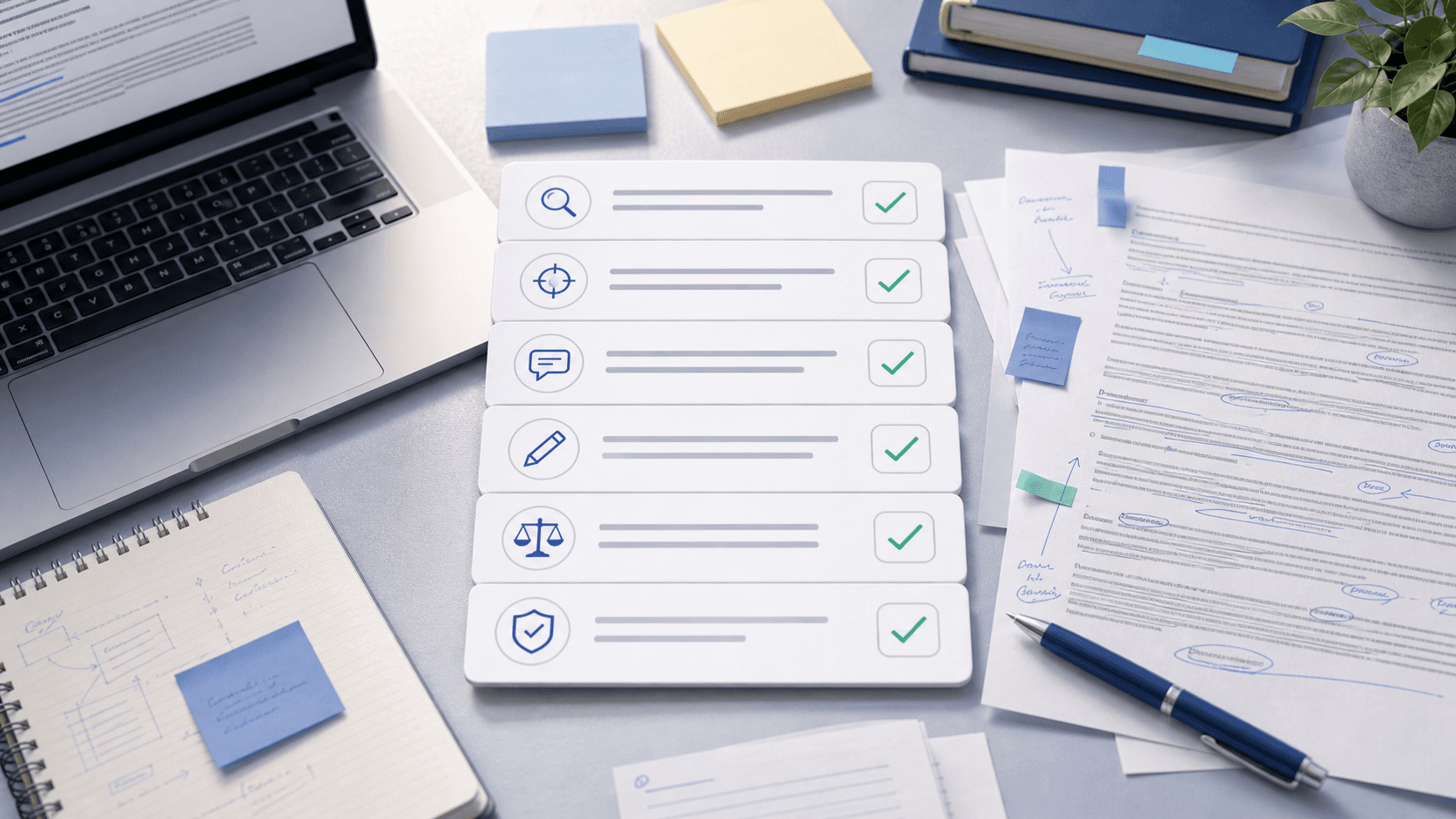
The best AI essay checkers for students help you catch problems before submission without making you lose control of the essay. They should help you improve clarity, structure, tone, citations, and AI-like patterns. They should not encourage blind rewriting.
That distinction is important. A student essay is not just a block of text. It is an argument built from reading, notes, sources, and decisions. A checker can support that work, but it cannot replace it.
This guide explains how to compare AI essay checkers, what features matter, and how to use them responsibly before you submit.
The first distinction is tool type: an AI essay checker is not the same thing as a grammar checker.
What an AI essay checker should do
A useful essay checker should help with more than typos.
It should check whether the writing is clear. It should identify awkward or generic sections. It should help you notice missing transitions, repetitive phrasing, and unsupported claims.
Some essay checkers include grammar suggestions. Some include AI detection. Some include plagiarism context. Some include readability feedback. Some help with citations.
The strongest workflow combines checking with revision. If the tool flags a section, you need a way to improve it.
That is where PassMyEssay fits. It gives students a focused place to humanize a draft, check for AI-like patterns, and compare output.
Best for AI-like patterns: PassMyEssay
PassMyEssay is useful for students who worry that their draft sounds too AI-generated or too generic.
The humanizer helps revise stiff sections. The AI check helps inspect the result. The side-by-side layout makes it easier to compare meaning.
That matters because many essay problems are not grammar problems. A sentence can be grammatically correct and still sound empty. A paragraph can be smooth and still lack evidence. A conclusion can be polished and still say nothing new.
PassMyEssay is strongest when you already have a draft and want to make it more natural while preserving the argument.
If you are using AI tools for school, disclosure matters because different schools have different rules.
Best for grammar and mechanics
Grammar checkers are still valuable. They catch punctuation mistakes, subject-verb agreement problems, unclear pronouns, and wordy phrasing.
Use grammar checking after you have revised the argument. If you run it too early, you may polish sentences that later need to be cut.
Grammar suggestions should be accepted selectively. Academic writing can be complex, and a checker may prefer simpler phrasing that changes emphasis.
The best grammar pass is slow. Read each suggestion. Ask whether it improves the sentence without changing meaning.
Best for AI detection
AI detection can be useful before submission, but it should not be the only check.
A detector estimates whether text resembles AI-generated writing. It does not prove authorship. It can be wrong. It can flag formal human writing and miss heavily edited AI text.
Use detection to locate paragraphs that deserve review. If a section is flagged, do not rewrite randomly. Look for the real writing issue.
Common causes include vague claims, repeated structure, generic transitions, and lack of personal or source-specific detail.
Best for plagiarism and source use
Plagiarism checking is different from AI detection. It compares text against existing sources or known matches. AI detection estimates generation patterns.
Students often confuse the two because both appear in "originality" workflows.
A plagiarism checker can help you find missing citations or wording that is too close to a source. But it cannot tell whether your argument is good.
Before submitting, check:
- Are all borrowed ideas cited?
- Are direct quotes in quotation marks?
- Are paraphrases genuinely rewritten?
- Does each source support the claim?
- Is the citation format correct?
Our guide on AI plagiarism vs AI detection explains this difference.
Best for structure
Some essay checkers give structure feedback. They may ask whether the thesis is clear, whether paragraphs have topic sentences, or whether the conclusion connects back to the main argument.
This is useful, but only if you use it thoughtfully.
Do not force every essay into a generic structure if the assignment asks for something else. A literature review, reflective essay, lab report, and argument essay have different expectations.
Use structure feedback as a prompt. Then check the actual assignment sheet.
Best for citations
Citation tools can help format references, but they are not perfect.
Students should check generated citations against the required style. Make sure author names, titles, dates, publishers, URLs, and access dates are correct.
Citation accuracy matters because it affects trust. A well-written essay with sloppy citations still looks unfinished.
If you used AI in a way that requires disclosure, follow the format your school provides. Do not guess.
A pre-submit checking workflow
Use this order:
- Read the prompt again.
- Check the thesis.
- Review each paragraph's purpose.
- Confirm evidence and citations.
- Humanize stiff or generic sections if allowed.
- Run AI checking as feedback.
- Run grammar checking.
- Check formatting.
- Read the essay out loud.
- Save the final version with drafts.
This order prevents the common mistake of polishing before revising.
How to choose an essay checker
Choose based on your biggest risk.
If your writing sounds robotic, choose a humanizer and AI checker.
If your grammar is weak, choose a grammar checker.
If your citations are messy, choose a citation tool.
If your source use is risky, choose plagiarism checking.
If your structure is unclear, choose an outline or essay feedback tool.
Most students benefit from a small stack rather than one giant tool.
Red flags
Avoid essay checkers that promise to make any essay undetectable. That is not a responsible claim.
Avoid tools that rewrite entire essays without showing what changed.
Avoid tools that do not explain privacy.
Avoid tools that create citations without giving you enough detail to verify them.
Avoid tools that encourage submitting work you cannot explain.
FAQ
What is the best AI essay checker for students?
The best checker depends on the need. PassMyEssay is useful for AI-like writing patterns because it combines humanizing and AI checking. Students may also need grammar, citation, and plagiarism tools.
Should I check my essay for AI before submitting?
You can, but treat the result as feedback. A detector does not prove authorship. Use it to find generic sections and revise them carefully.
Can an essay checker improve my grade?
It can help you catch problems, but your grade depends on the assignment, argument, evidence, structure, and instructor expectations.
Is grammar checking enough?
No. Grammar checking helps with surface polish, but essays also need ideas, evidence, and structure.
How to avoid feedback overload
AI essay checkers can give a lot of feedback at once. That can be useful, but it can also make students edit in circles.
The best way to avoid overload is to rank feedback by importance.
Start with the prompt. If the essay does not answer the question, grammar suggestions do not matter yet.
Next, check the thesis. A clear thesis gives every paragraph a job.
Then check evidence. Each body paragraph should include enough support to make the claim believable.
After evidence, check explanation. Many essays include a quote or source detail but do not explain why it matters.
Only then should you focus on sentence polish, AI-like style, grammar, and formatting.
This order keeps the essay from becoming a clean version of a weak argument.
What a good checker cannot do
A checker cannot know your full class context unless you provide it. It may not understand what your instructor emphasized, which readings matter most, or how your rubric weighs evidence.
It cannot verify every citation automatically.
It cannot decide whether your personal example is honest.
It cannot guarantee that a detector will score the essay a certain way.
It cannot replace your final read.
That does not make checkers useless. It means they are assistants, not judges.
A paragraph-level test before paying
Before paying for an essay checker, test it on one strong paragraph and one weak paragraph.
The strong paragraph should include a clear claim, evidence, and explanation. The weak paragraph should be vague or repetitive.
A good checker should treat those paragraphs differently. It should not only correct grammar. It should help you see why the weak paragraph needs more substance.
If the tool gives both paragraphs the same kind of feedback, it may be too shallow for essay revision.
How PassMyEssay fits with other checkers
PassMyEssay is strongest for the humanizing and AI-checking part of the process.
You may still use another tool for citations or grammar. That is fine. A good student workflow can include more than one tool.
The key is order. Use PassMyEssay when the issue is robotic phrasing or AI-like rhythm. Use a grammar checker when the ideas are stable. Use a citation tool when you are formatting sources. Use your assignment sheet for final judgment.
No single tool should control the whole essay.
A realistic student tool stack
A good student stack is usually smaller than people think.
Use your assignment sheet as the first "tool." It tells you what the essay must do.
Use your notes and sources as the second tool. They give the essay substance.
Use PassMyEssay when the draft sounds stiff, AI-like, or too generic. It helps with humanizing and AI checking.
Use a grammar checker after the ideas are stable.
Use a citation tool or style guide at the end.
That stack covers the main risks without turning revision into a maze.
The order matters. If you humanize before adding evidence, the output may sound smoother but remain thin. If you grammar-check before fixing the thesis, you may polish sentences that do not belong. If you check for AI patterns before reading the essay yourself, you may overreact to a score.
Good revision is staged. Each tool has a role.
What to check on the final read
On the final read, ignore tools for a few minutes.
Read the introduction and ask whether it makes a real claim. Read each topic sentence and ask whether it supports that claim. Read every quote or source detail and ask whether you explained it. Read the conclusion and ask whether it does more than repeat the introduction.
Then check whether any humanized sections still sound like you. The final essay should be cleaner, but it should not feel detached from your thinking.
That final read is where student judgment matters most.
Quick recommendation
Choose an essay checker based on the weakest part of your current draft.
If the argument is weak, use a structure checklist before any AI tool. If the sentences are awkward, use grammar support. If the draft sounds AI-like, use PassMyEssay to humanize and check sections. If citations are messy, use citation support.
The best checker is not the one with the most features. It is the one that helps with the next real problem.
For most students, PassMyEssay works best in the middle of revision, after ideas are drafted and before final proofreading.
Use it there, then read the final essay yourself.
Final practical rule
If a checker gives twenty suggestions, do not treat them equally. Fix meaning first, evidence second, clarity third, grammar fourth, and formatting last. That order protects the essay from becoming polished but shallow.
One more note: the final version should still sound like a student who can talk through the essay. If the checker produces language you would never use in a class discussion, revise it back into your own voice before submitting. That final ownership matters because instructors grade understanding, not just polished sentences alone on the page itself.
A useful checker should make the next revision clearer. If it only adds another score to worry about, it has not helped the student do better work.
Final thoughts
The best AI essay checkers for students make revision clearer. They help you notice problems before submission and fix them responsibly.
Use the right tool for the right stage. Keep your process. Read the final draft yourself. That is how checking becomes useful instead of stressful.
Keep Reading
Related guides
Best AI Detectors for Essays and Students: How to Compare Them Fairly
A student-friendly guide to the best AI detectors for essays, including accuracy claims, false positives, flagged passages, privacy, and revision workflow.
Best Turnitin Alternatives for Students: AI Checking and Revision Options
Compare student-friendly Turnitin alternatives for AI checking, essay revision, humanizing, process evidence, and responsible pre-submit review.
Best AI Detector for Students: What to Look For Before You Trust a Score
Find the best AI detector for students by looking at highlighted evidence, explanations, privacy, score clarity, and revision support.
AI Writing Policy for Students: What Schools Usually Allow and Ban
A practical guide to AI writing policy for students, including brainstorming, outlining, grammar help, humanizing, disclosure, and process evidence.
Make your draft clearer
Use PassMyEssay to rewrite AI-assisted text responsibly, check weak sections, and keep your meaning intact.
Try PassMyEssay