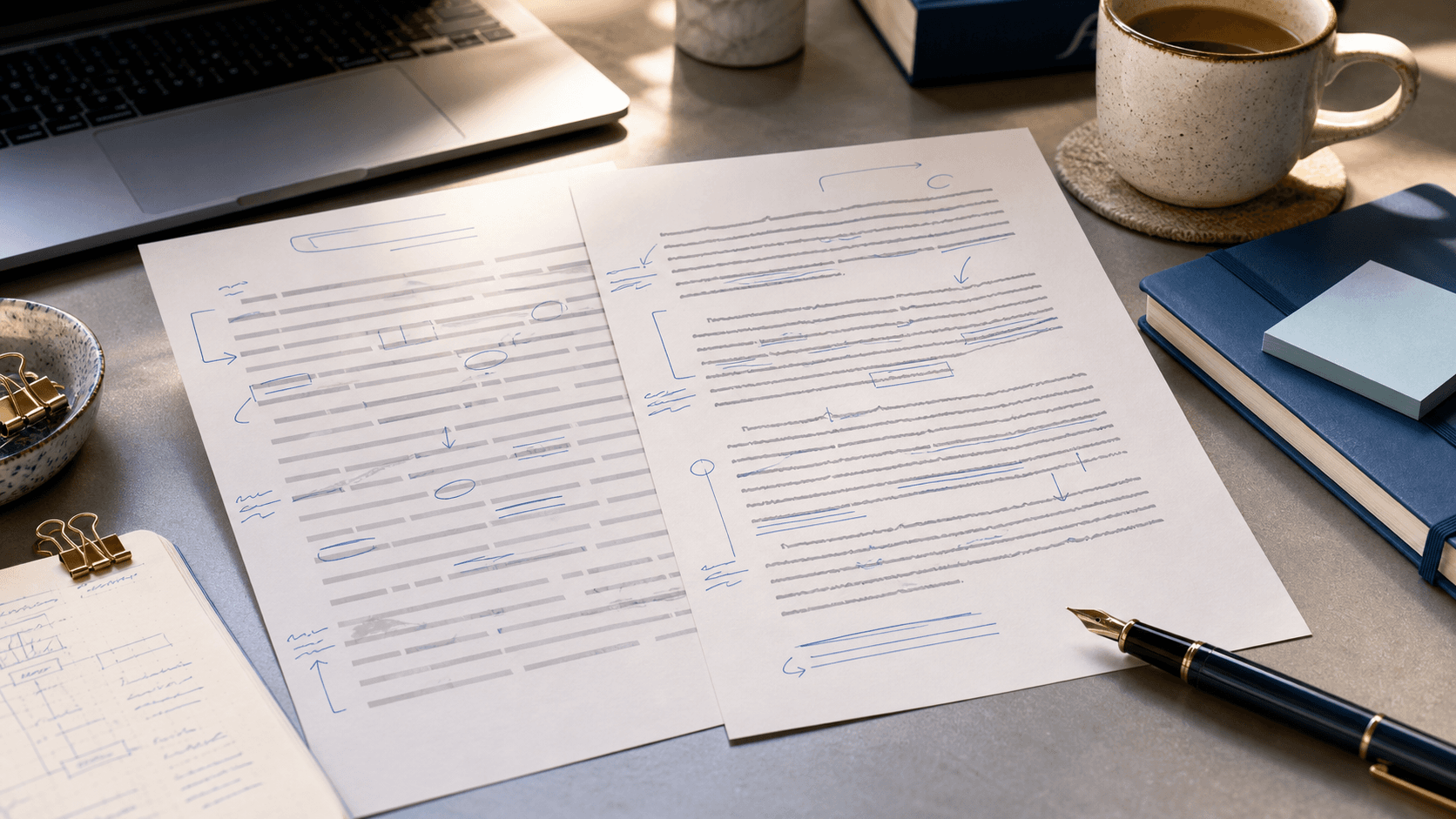
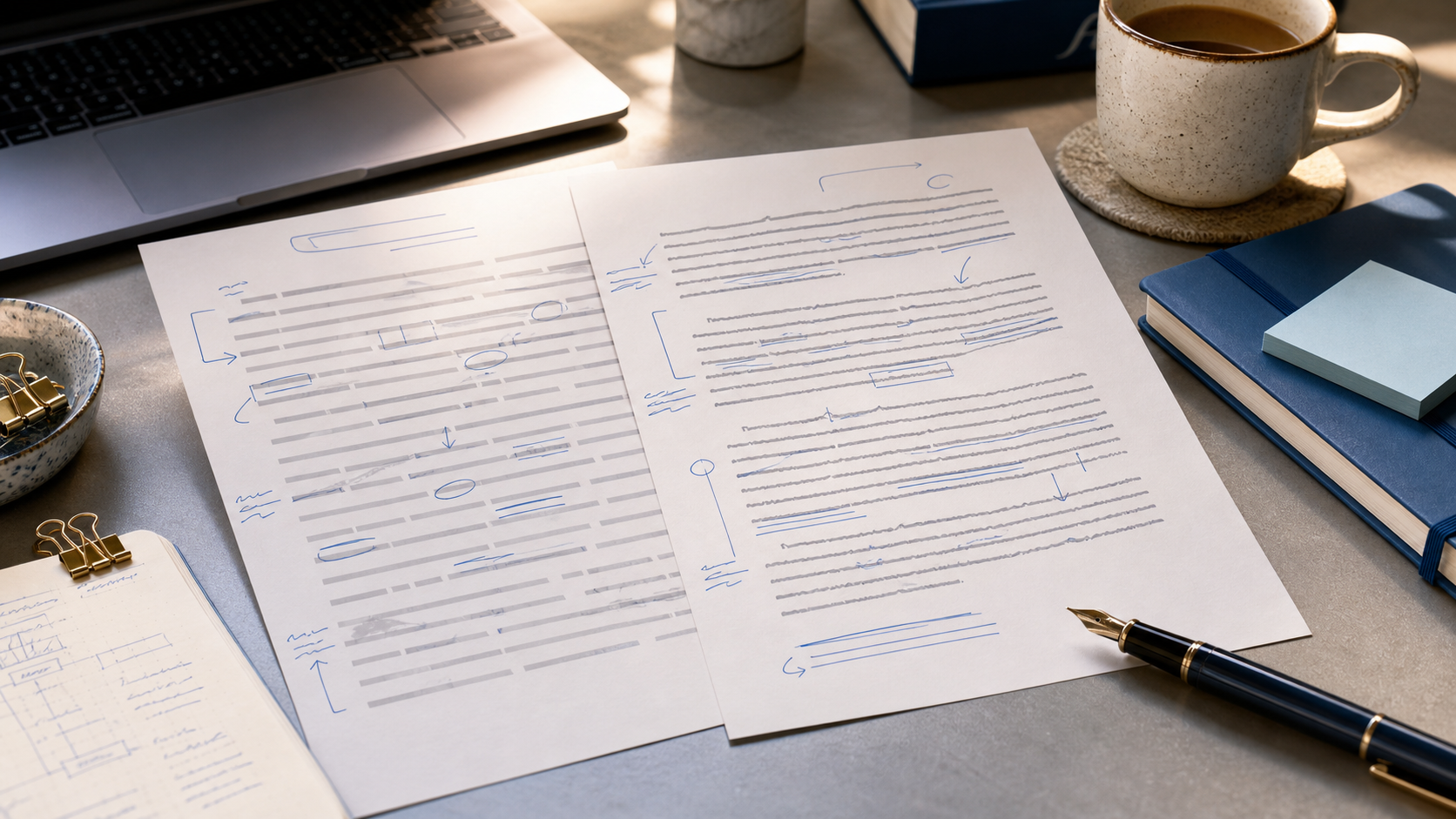
Search AI writing for non-native English speakers and you mostly get tool roundups—Grammarly for fluency, Claude for tone, Diglot or Engram for bilingual drafting. Those help with mechanics. What they skip is the student problem: how to use AI for clarity without erasing your argument, how formal L2 prose gets misread by detectors, and what to do after you paste from ChatGPT.
This guide is a repeatable workflow for multilingual students writing essays and papers in English. You will leave with prompts that fix one sentence at a time, a list of errors worth targeting by hand, and a cleanup step for invisible paste residue. Related reading: AI writing for non-native English speakers, AI detector false positives for non-native English writers, and academic tone guide.
Key Takeaways
What “good help” looks like (and what it does not)
Useful AI help for L2 academic writing:
- Explains why an article or preposition failed in your sentence
- Offers two or three rewrites so you choose
- Flags empty transitions and stock ChatGPT phrases
- Leaves claim strength, hedges, citations, and culturally specific examples alone
Harmful “help”:
- One-click “make this sound native / professional / like a native speaker”
- Full-essay paraphrases you cannot explain aloud
- Hedge upgrades (“suggests” → “proves”) that overstate evidence
- Invented sources or smoothed-over citations
- Chasing “undetectable” scores instead of clearer, sourced prose
If a rewrite removes something only you would know—your fieldwork site, your high-school exam system, your precise hedge—reject it. Clarity is the goal; mimicry is not.
The five-step workflow
1. Dump ideas before polishing English
Write a messy draft in whatever mix of English and notes you think in. Get claims, evidence stubs, and examples on the page. Separating thinking from mechanics is the single highest-leverage habit for multilingual writers. Outline help without outsourcing the argument: turn AI notes into an essay outline.
2. Ask for explanations, not ghostwriting
Paste one sentence you know is wrong. Prompt pattern:
"Explain the article/preposition error in this sentence for a [your L1] speaker. Then give two corrected versions. Keep my example about [X]. Do not change how strong the claim is.
Write the version you understand. That builds a personal error log faster than accepting bulk rewrites.
3. Controlled options only
For dense paragraphs, ask: “Suggest two clearer versions of this paragraph; keep all citations and hedges; do not add idioms.” Compare line by line. Accept grammar and word-order fixes; reject voice swaps and deleted nuance. Responsible boundaries: responsible AI writing for students and ChatGPT essay writing guide.
4. Clean ChatGPT paste before it enters your master file
Copied chat text can carry invisible Unicode watermarks and templated AI phrasing that survives visual proofreading. Run that paste through PassMyEssay—a ChatGPT watermark remover on the homepage that strips hidden characters, rewrites stock AI wording, and locks meaning. Free try at /. Then re-check every citation and hedge.
5. Restore voice keepers and disclose
Reinsert examples, place names, and careful hedges tools softened. Disclose tools and tasks per course policy—student guide to AI disclosure. Read aloud once: if it sounds like a brochure, add specificity (why AI writing sounds robotic).
Priority error list (manual + AI-assisted)
Work these in order. Ask the model to quiz you on your recurring misses—not to rewrite whole chapters.
| Pattern | Typical slip | Better ask |
|---|---|---|
| Articles | “the society,” missing a/an before countable nouns | “Explain article use in this sentence for [L1] speakers.” |
| Prepositions | discuss about, depend of, good in English | “Which preposition collocates with this verb here?” |
| Tense in lit reviews | Mixing past simple and present perfect randomly | “Make tense consistent with APA lit-review norms; keep meaning.” |
| Collocations | do a research, strong engine | “Suggest natural academic collocations; keep technical terms.” |
| Hedge calibration | Model deletes may / suggests | “Preserve hedge strength; only fix grammar.” |
Field terminology beats “simpler English.” An AI that swaps your methods phrase for blog language is not helping. Tone by genre, not by Midwest casual speech: academic tone guide.
Prompts that preserve identity
Copy and adapt:
- Sentence coach: “Correct grammar only. Do not change examples, hedges, or citations.”
- Two options: “Give two clearer versions of this sentence. Label differences. I will choose.”
- L1 quiz: “Based on these five mistakes I make, quiz me with five new sentences and explain each answer.”
- Register shift: “More formal for a journal abstract—but keep my claim strength and technical nouns.”
- Never: “Rewrite the whole essay so it sounds like a native speaker wrote it.”
Prompting idea generation in your first language can surface angles English-only prompts miss; switch to English for grammar and final phrasing. Keep that split deliberate.
Detector bias: plan evidence, do not game scores
Detectors often reward lexical surprise and uneven rhythm—patterns common in casual native drafts, less common in careful ESL essays built from taught templates. Campus reports and research document elevated false-positive risk for multilingual writers. That is an equity problem, not proof you cheated.
Practical protections:
- Save outlines, notes, and version history as you write
- Keep an early draft with your characteristic errors
- Ask instructors how AI tools and detectors factor into grading
- If flagged, present process evidence—how to show your writing process if your essay is flagged
Revise flagged sections for specificity (course terms, source detail), not only for lower detector numbers. Broader context: AI detector false positives and the dedicated non-native guide linked above. Bypass tools trade one risk for another; they are not a writing strategy.
Humanizers without identity erasure
If you use a humanizer after AI-assisted editing, treat it as pattern cleanup, not biography rewrite. Safe targets: repeated openings, empty transitions (Furthermore, In today’s world), invisible Unicode, stock ChatGPT cadence. Protected targets: your examples, technical terms, hedges, citation placement.
Deep dive: humanize AI text without losing your voice. Tool landscape: best AI humanizer for essays. International students should optimize for explainable, sourced, disclosed work—not a fake native voice.
Build English beyond the chatbot
- Read one paper weekly in your field; copy three sentence shapes into a notebook
- Keep an “errors I make” list with your corrected examples
- Use the writing center for clarity marks, not full rewrites
- Practice oral explanation of each paragraph—if you can say it, you own it
Tool map by stage: AI writing tools for students. Language growth still happens in reading, revision, and feedback.
Talk to instructors early
When policy allows, ask before the deadline:
"May I submit an outline and draft history with my essay? English is my second language, and I want to document my process.
Proactive transparency reduces adversarial flags and shows the responsibility instructors notice at grade boundaries. Policy framing: AI writing policy for students.
Bottom line
Use AI to explain patterns and offer sentence options—not to manufacture a native persona. Keep culturally specific evidence and honest hedges. After any ChatGPT paste, clean watermarks on PassMyEssay—the ChatGPT watermark remover at /—then restore the lines only you would write, disclose honestly, and keep drafts that prove authorship. Clarity polishes the glass; your perspective is still the view.
Keep Reading
Related guides
AI Detector False Positives for Non-Native English Writers: Why ESL Essays Get Flagged
Stanford-linked research found ~61% false positives on TOEFL essays. Learn why perplexity-based detectors punish careful L2 English—and how to document authorship without erasing your voice.
Responsible AI Writing for Students: A Practical Ethics Checklist
Responsible AI writing for students — ownership tests, syllabus rules, disclosure, citation verification, and ChatGPT paste cleanup when help is allowed.
Why AI Writing Sounds Robotic: 10 Named Patterns (With Fixes)
Why AI writing sounds robotic — low burstiness, filler transitions, hedge stacks, rule-of-three padding, and ChatGPT paste watermarks — with named patterns and before/after fixes.
AI Writing Policy for Students: A Practical Syllabus Decoder
Decode your course AI writing policy: find the rule, map ban/assist/edit/disclose bands, email when silent, and clean ChatGPT paste only when help is allowed.
Make your draft clearer
Use PassMyEssay to rewrite AI-assisted text responsibly, check weak sections, and keep your meaning intact.
Try PassMyEssay